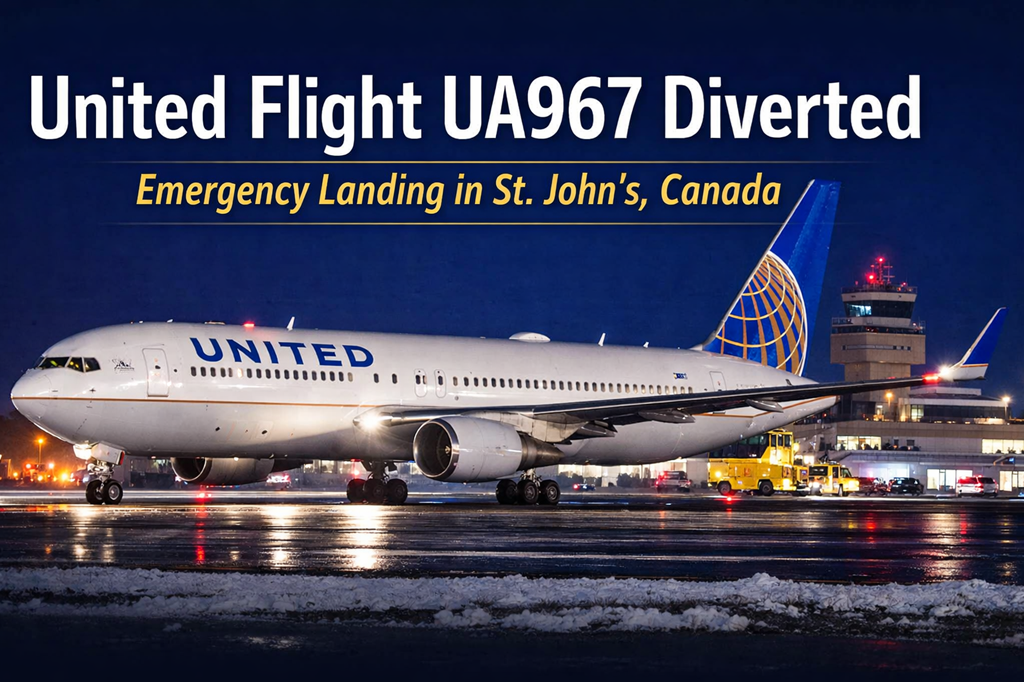
United Flight UA967 was diverted to St. John’s, Canada, on August 24–25, 2025, after a reported burning smell was detected in the cockpit during its transatlantic flight from Naples to Newark. The aircraft landed safely with no injuries and no confirmed fire. The diversion followed standard aviation safety procedures and was made as a precautionary response to a potential electrical issue.
This article explains what happened, why the decision was unavoidable, and how this incident fits into the broader picture of air travel safety.
What Is United Flight UA967
United Flight UA967 is a regularly scheduled long haul international service operated by United Airlines. In its current configuration, the route connects Naples International Airport in Italy with Newark Liberty International Airport in the United States, crossing the North Atlantic under international flight rules.
The flight is commonly operated using a Boeing 767-300, a wide-body aircraft designed for long range operations.
The August 2025 Diversion: What Happened
Departure Conditions in Naples
On August 24, 2025, United Flight UA967 departed Naples later than scheduled. The delay, reported to be approximately three hours, was related to weight restrictions, a routine but critical operational calculation for long haul flights carrying passengers, fuel, and cargo.
Once the aircraft departed, the flight proceeded normally during the early phase of the crossing.
Detection of a Burning Smell
Several hours into the flight, crew members detected a burning odor, described by reports as potentially electrical in nature. Passengers later indicated that the smell was noticeable but not accompanied by smoke, alarms, or visible fire.
In aviation, unexplained cockpit odors are treated as a serious warning sign, regardless of intensity.
Emergency Declaration and Diversion Decision
Following established procedures, the flight crew declared an emergency and elected to divert rather than continue across the Atlantic. This decision was based on safety protocol, not panic, and reflected standard international aviation practice.
The aircraft was rerouted to St. John’s International Airport, a primary diversion airport for transatlantic flights.
Safe Landing in St. John’s
United Flight UA967 landed safely in St. John’s during the late hours of August 24 into August 25. Emergency services were present as required, but no active hazard was found upon landing.
Passengers confirmed:
- The odor dissipated after crew intervention
- There was no fire
- No injuries were reported
- The landing was calm and controlled
Why a Burning Smell Requires Immediate Action
Smells Can Signal Electrical Risk
Modern aircraft rely on complex electrical systems for navigation, communication, and flight control. A burning smell, even without smoke, can indicate:
- Overheating wiring or insulation
- Electrical component failure
- Environmental system irregularities
- External odors entering ventilation
Because electrical failures can escalate rapidly, crews are trained to assume risk until ruled out.
Regulations Require Conservative Decisions
International aviation regulations do not allow crews to “wait and see” during long ocean crossings. If a potential safety issue cannot be conclusively resolved in flight, the aircraft must land at the nearest suitable airport.
The diversion of United Flight UA967 was therefore not discretionary. It was mandatory.
Why St. John’s Was Chosen
St. John’s International Airport is one of the most strategically important airports in North Atlantic operations.
It offers:
- Runways capable of handling wide-body jets
- Full emergency and fire response teams
- Maintenance and inspection facilities
- Geographic proximity to transatlantic routes
For a westbound flight already over the Atlantic, St. John’s represents the safest and fastest option.
Passenger Experience and Public Reaction
Passengers shared their experiences online shortly after landing. While frustration over delays was understandable, most accounts emphasized professionalism and transparency from the crew.
Common observations included:
- Clear announcements from pilots and cabin crew
- A calm cabin atmosphere
- Relief after landing safely
- Acknowledgment that safety took priority over schedule
Social media reports consistently confirmed no injuries and no confirmed mechanical fire.
Other Reported UA967 Disruptions Explained
January 2026 Weather-Related Diversion
Separate reports in early 2026 referenced a diversion involving UA967 due to adverse weather at the destination. Details varied by source, and no mechanical issue was cited in those accounts. Weather diversions are among the most common and routine in commercial aviation.
July 2024 Compensation Discussions
In mid-2024, online discussions referenced a diverted UA967 flight and passenger compensation rights. These conversations focused on airline policy and extraordinary circumstances rather than safety incidents.
Important Clarification
Each event involved different causes, different operational contexts, and different outcomes. Sharing a flight number does not mean the events are related.
Historical Context: Why Flight Numbers Can Be Misleading
In 2010, the flight number UA967 was associated with a domestic United Airlines route that diverted due to severe turbulence, resulting in injuries. That incident involved:
- A different route
- A different aircraft
- A different era of operations
Flight numbers are reused over time. Past incidents tied to a number do not reflect the safety record of current flights operating under the same designation.
What Happens After a Diversion
Once on the ground, an aircraft does not resume service automatically.
Standard post-diversion steps include:
- Full mechanical and electrical inspections
- Maintenance documentation and diagnostics
- Regulatory clearance
- Crew duty time evaluation
- Passenger rebooking and accommodation planning
These steps ensure that safety concerns are fully addressed before any further operation.
Why This Incident Shows the System Working
The diversion of United Flight UA967 did not escalate into an emergency because it was handled early.
This event demonstrates:
- Crew training that prioritizes caution
- Airline policies that support conservative decisions
- International cooperation between airports
- A safety culture that values outcomes over schedules
The most successful safety events are often the quiet ones.
Perspective: Why Diversions Are Not Failures
Diversions feel disruptive to passengers, but they represent one of aviation’s strongest safety tools. They exist so that uncertainty never has to turn into danger.
When a flight diverts, it means:
- A risk was identified
- The risk was respected
- A safer option was chosen
United Flight UA967 diverted because the system worked as designed.
Read More | United Flight UA109 Diversion
Final Thoughts
United Flight UA967 diverted due to a reported burning smell, landed safely in Canada, and concluded without injuries or damage. While the delay affected travel plans, the outcome reflects disciplined decision-making and a safety-first mindset.
In modern aviation, arriving later is always better than pressing forward without certainty. This incident stands as a quiet reminder that behind every smooth landing is a network of rules, training, and judgment focused on one goal: getting everyone safely back on the ground.