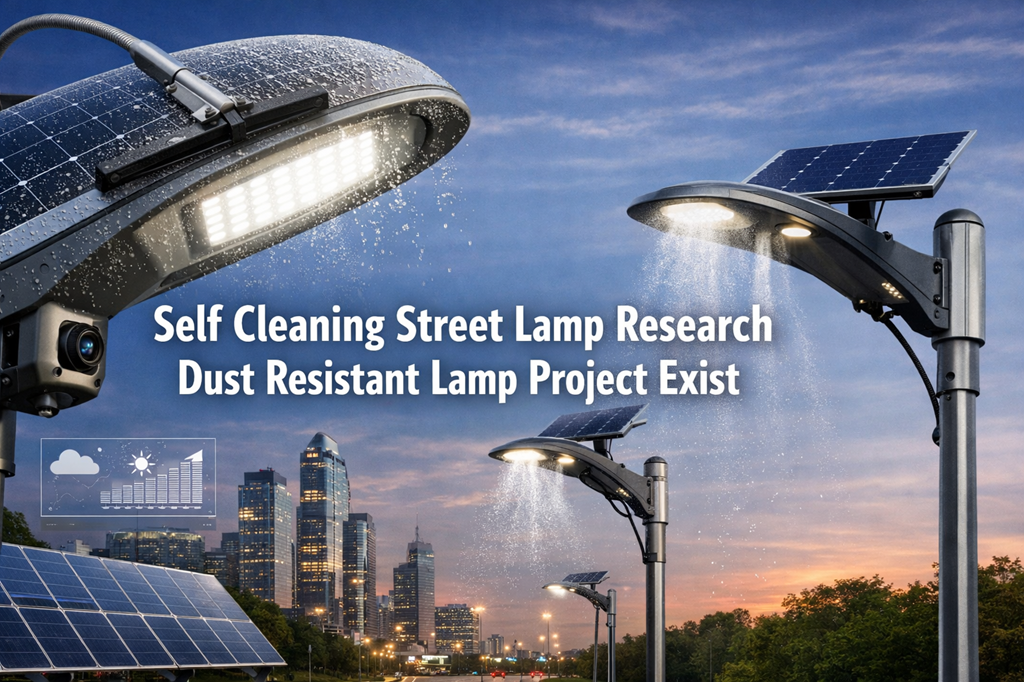
Yes, self cleaning street lamp research and dust resistant lamp projects do exist, and they are no longer limited to theory, student prototypes, or isolated lab tests. In 2026, this field stands as a practical, field-validated area of smart infrastructure development. Engineers, researchers, and manufacturers actively deploy these systems to solve one persistent problem: dust severely degrades street lighting performance and raises long-term maintenance costs.
This article explains the concept clearly, examines real technologies in use, highlights existing projects, and shows why self-cleaning street lamps matter for modern cities and remote environments.
What Does “Self Cleaning Street Lamp Research Dust Resistant Lamp Project Exist” Mean?
The phrase describes structured research and development projects that test whether street lamps can resist dust buildup or clean themselves automatically under real environmental conditions.
In technical and academic contexts, the word exist means:
- The concept has passed feasibility testing
- Functional prototypes or commercial products are available
- Performance has been measured outside laboratory conditions
In simple terms, these projects are real, operational, and already delivering value.
Why Dust Is a Serious Problem for Street Lamps
Street lamps operate outdoors every hour of the year. Because of this, dust exposure creates long-term performance issues.
Dust causes:
- 10–40% reduction in light output due to blocked optics
- Up to 30% loss in solar panel efficiency for solar street lights
- Increased cleaning and labor costs
- Heat buildup that shortens LED and battery lifespan
- Reduced road safety from uneven illumination
As cities expand and labor costs rise, manual cleaning becomes unsustainable. Therefore, dust-resistant and self-cleaning designs are now an infrastructure necessity, not an upgrade.
What Is a Self-Cleaning Street Lamp?
A self-cleaning street lamp is a lighting system designed to automatically prevent, repel, or remove dust from critical surfaces, including:
- Lamp lenses and covers
- Solar panels
- Optical reflectors
- Sensors and cameras
The goal is simple: stable illumination and energy efficiency with minimal human intervention.
How Self Cleaning Street Lamp Research Projects Work
Successful projects follow a layered engineering approach. Instead of relying on one solution, they combine materials science, mechanical systems, and smart control logic.
1. Mechanical Self-Cleaning Systems
This is the most proven and commercially adopted solution today.
How it works
- A low-power motor drives a soft brush or wiper across the solar panel or lamp surface
- Cleaning occurs at scheduled times, often early morning or dusk
- Energy consumption remains minimal to protect batteries
Why it works
Mechanical cleaning physically removes dust, making it effective even in deserts where rain never arrives.
2. Water Spray and Hybrid Cleaning Systems
Some research projects integrate controlled water spray with brushing.
Advantages
- Removes sticky dirt and bird droppings
- Useful in urban and industrial zones
Limitations
- Water availability restricts desert use
- Adds complexity and maintenance
As a result, water-based systems appear mainly in urban research pilots, not arid regions.
3. Nanotechnology and Dust-Resistant Coatings
Material science plays a growing role in dust resistance.
Common approaches include:
- Hydrophobic coatings that repel water and dust
- Photocatalytic coatings that break down surface contaminants under light
- Anti-static layers that reduce particle attraction
These coatings reduce dust adhesion, although they usually perform best when combined with physical cleaning.
4. Sensor-Driven Automation
Automation ensures cleaning occurs only when necessary.
Typical systems monitor:
- Light output levels
- Solar charging performance
- Dust or opacity thresholds
When performance drops, the system triggers cleaning automatically. This approach protects energy reserves and extends component life.
5. IoT-Enabled Monitoring and Control
Advanced projects integrate IoT connectivity.
This enables:
- Remote performance monitoring
- Predictive maintenance scheduling
- Faster fault detection
Self-cleaning street lamps therefore align naturally with smart city infrastructure.
Dust Resistance Beyond Cleaning
Cleaning alone is not enough. Dust-resistant projects also focus on protection and durability.
Key design elements include:
- Fully sealed lamp housings
- High ingress protection ratings such as IP66 or IP67
- Corrosion-resistant materials
- Anti-jamming mechanisms for moving parts
These features prevent internal contamination and ensure long service life in polluted or sandy environments.
Existing Research and Commercial Projects
Academic and Research Projects
Universities and research institutes across Asia, Europe, and the Middle East actively develop:
- Autonomous self-cleaning solar street lamps
- Energy-efficient cleaning algorithms
- Long-term dust exposure studies
Results consistently show improved light stability, reduced maintenance cycles, and better energy efficiency.
Commercially Deployed Solutions
Several manufacturers already offer self-cleaning or dust-resistant street lamps for real-world use.
Notable examples include:
- Gletscher Energy, which designs solar street lights for desert resilience
- Luxman, offering automated cleaning mechanisms
- Sresky, integrating brush-based cleaning and smart fault alerts
These products confirm that self-cleaning street lamp projects exist beyond academic research.
Where Self-Cleaning Street Lamps Deliver the Highest Value
These systems offer the strongest return on investment in:
- Desert highways and rural roads
- Industrial and mining zones
- Remote off-grid solar installations
- Smart city pilot corridors
- Coastal construction regions
In such environments, reduced maintenance alone often justifies adoption.
Challenges Still Being Addressed
Despite strong progress, some challenges remain:
- Long-term durability of nano-coatings
- Mechanical wear in moving parts
- Higher upfront cost than basic lamps
- Environmental variability between regions
However, continuous research steadily reduces these limitations.
Future Direction of Self Cleaning Street Lamp Research
Looking ahead, development focuses on:
- Hybrid systems combining coatings and mechanical cleaning
- AI-driven dust prediction and adaptive cleaning schedules
- Self-powered cleaning using vibration or wind energy
- Deeper integration with smart city platforms
As technology matures and costs decline, self-cleaning features are expected to become standard rather than optional.
Final Answer: Does the Project Exist?
Yes. Self Cleaning Street Lamp Research Dust Resistant Lamp Project Exist in both research environments and real-world deployments.
These projects already improve lighting reliability, reduce operational costs, and support sustainable urban infrastructure. While innovation continues, self-cleaning and dust-resistant street lamps are no longer future concepts. They are proven, practical solutions for cities, highways, and remote installations worldwide.