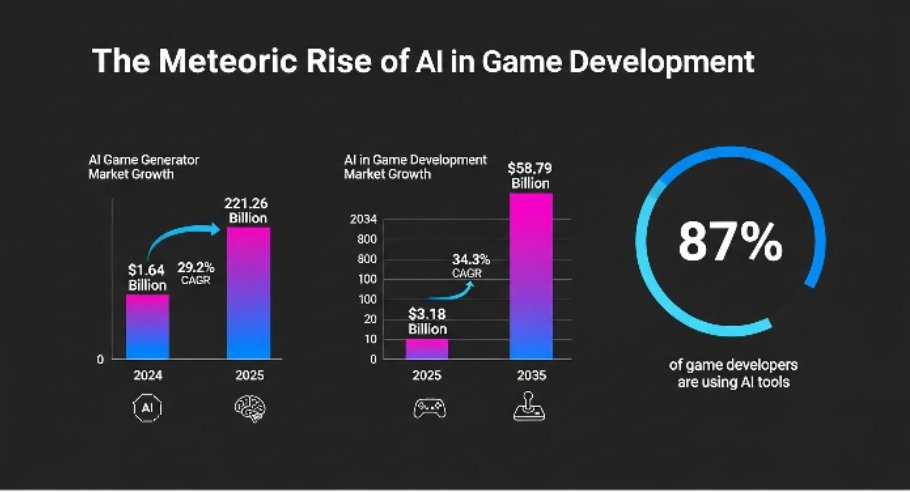
The rapid adoption and projected market growth of AI in game development highlight its transformative impact on the industry.
The dream of creating your own video game, once a journey requiring years of dedicated study and mastery of complex software, is rapidly transforming. The landscape of game development is experiencing a seismic shift, driven by the burgeoning capabilities of Artificial Intelligence. On one side, we now have no-code game maker platforms that promise to bring video games to life in minutes, often through simple text prompts. On the other hand, the established, time-tested methodology of traditional game development continues to offer unparalleled depth and control. For aspiring creators, indie game developers, and even seasoned professionals, the question arises: which path is superior?
This comprehensive guide delves into the core of AI in Video Game Development, comparing the efficiency and accessibility of AI Game Builders with the robust power of traditional game development to help you make the best choice for your project. The global AI Game Generator Market is projected to reach USD 21.26 billion in 2034, a significant jump from USD 1.64 billion in 2024, growing at a compound annual growth rate (CAGR) of 29.2% [Vertex AI Search, 2025]. Similarly, the global AI in Game Development Market is estimated to be valued at USD 3,175.3 million in 2025 and is further anticipated to reach USD 58,788.0 million by 2035 at a CAGR of 34.3% [Vertex AI Search, 2025]. These figures underscore the monumental growth and investment in AI-driven game development. Furthermore, a recent survey found that 87% of game developers are using AI agents in their workflows [Google Cloud and The Harris Poll, 2025], indicating a widespread adoption of these transformative AI tools.
What Is an AI Game Builder?
An AI Game Builder represents a significant leap in game creation accessibility. These platforms leverage advanced Artificial Intelligence, particularly generative AI, Machine Learning AI, and Deep Learning techniques, to automate much of the intricate work involved in bringing a game to life. Instead of requiring extensive coding knowledge or manual asset placement, users interact with these systems primarily through natural language prompts. The AI interprets these instructions, generating the necessary game logic, Game Assets, game environments, and even NPC dialogue. This shift fundamentally democratizes game development, lowering the barrier to entry and enabling individuals with little to no prior technical expertise to conceptualize and construct playable experiences. These AI tools allow for rapid iteration and the creation of AI-generated content, making them powerful allies for creators looking to quickly realize their visions.
How AI Game Makers Work
An AI Game Builder translates a user’s natural language prompt into multiple game components, like code, art, and levels, to automatically generate a playable experience. The engine behind an AI Game Builder operates much like a sophisticated interpreter. A user describes their desired game in plain English – for instance, Create game set in a mystical forest where players manipulate elemental forces to solve ancient riddles.” The generative AI within the platform then processes this narrative, translating it into executable code and visual elements. This involves extensive use of Neural networks and, for complex language understanding, often transformer-based language models.
Behind the scenes, these platforms are adept at content generation, encompassing everything from AI-generated art and textures to procedural generation of game worlds and game environments. For instance, a prompt might trigger the AI to create unique online Game Assets like trees, rocks, and player characters, and then use procedural generation to populate a vast game world. Dialogue systems can be powered by AI-driven dialogues, creating dynamic and responsive NPC dialogue that adapts to the player’s actions. Tools like Adobe Firefly exemplify the capabilities of image GenAIs in creating visual assets, while platforms like AI Dungeon 2 showcase the potential for generative AI in narrative creation. These AI tools effectively automate asset production and basic game design elements, offering a streamlined path for content creation.
Typical Use Cases for AI / No-Code Game Makers
The primary advantage of AI Game Builders lies in their speed and accessibility, making them ideal for specific scenarios. They are particularly powerful for:
- Beginners and Hobbyists: Individuals passionate about video games who wish to bring their ideas to life without the steep learning curve of traditional programming. They can quickly experiment with game-designing concepts and build simple interactive media.
- Educators and Students: Facilitating learning about game design principles and logical sequencing by allowing students to focus on concepts rather than syntax errors. AI tools can help demonstrate procedural generation and basic game logic.
- Rapid Prototyping: Allowing game developers and designers to quickly test core mechanics, loops, and concepts for new video games in minutes rather than days or weeks. This is invaluable for validating ideas before committing significant resources. For example, testing a new adaptive gameplay mechanic can be done almost instantly.
- Casual and Social Experiences: Creating simple, engaging experiences for web or mobile platforms where complexity and deep customization are not primary goals. This could include mini-games, interactive educational modules, or social interactive media.
- Content Generation Assistance: Leveraging AI tools for content generation, such as drafting NPC dialogue, creating variations of Game Assets, or generating initial game environments, can significantly accelerate asset production in even more complex projects.
These use cases highlight how AI Game Builders democratize game development by making it more approachable and faster for certain types of projects.
What Is Traditional Game Development?
Traditional game development is the established, comprehensive process that has underpinned the creation of virtually every professional video game to date. It is the methodology employed by major Game Studios and dedicated indie teams, involving a deep and granular control over every aspect of the game’s creation. This approach relies on well-defined pipelines, specialized roles, and a profound understanding of underlying technology to build complex, polished, and performant interactive experiences. The global games market is expected to reach $197 billion in 2025, growing +7.5% year-on-year [Newzoo, 2025], a testament to the enduring power and commercial success of traditional game development. This method prioritizes meticulous craftsmanship, deep system design, and extensive optimization, often utilizing powerful engines like Unreal Engine or Unity Technologies.
Tools and Workflow in Traditional Game Dev
The heart of traditional game development lies in powerful game engines such as Unreal Engine and Unity Technologies. These engines provide a robust framework for creating everything from simple 2D games to sprawling 3D game worlds. Game developers utilize programming languages like C# (for Unity) or C++ (for Unreal Engine) to write the intricate logic that governs gameplay mechanics, AI behaviors, and the overall interaction within the game environments. While modern engines increasingly incorporate visual scripting tools (like Unreal Engine’s Blueprints), the fundamental workflow remains rooted in explicit instruction and technical mastery. Game developers are not merely describing what they want; they are meticulously detailing how it should be achieved, managing performance, memory, physics, and complex systems. Asset production involves specialized software for 3D modeling, texturing, animation, and sound design. Techniques like motion capture are employed to create realistic character movements. Rule-based AI, Finite state machines, and behavior trees are common methods for implementing combat AI, Pathfinding AI, and the logic for NPCs and smarter enemies. This detailed approach allows for unparalleled precision in game design.
Where Traditional Pipelines Shine
Traditional game development is the undisputed leader when a project demands ultimate control, deep customization, and extensive scalability. Its strengths are most evident in:
- AAA Productions: The creation of high-budget, visually stunning games with hyper-realistic graphics, complex physics simulations, and intricate narrative structures. These projects require a level of detail and polish that is best achieved through meticulous hand-crafting and fine-grained control.
- Competitive Multiplayer Experiences: Games requiring extremely precise networking code, low latency, robust anti-cheat measures, and highly optimized performance to handle thousands of concurrent players. The ability to fine-tune performance and manage network traffic is critical here.
- Custom Optimization and Platform Specificity: Projects that need to run flawlessly on a wide range of hardware, from high-end PCs and current-generation consoles to specialized virtual reality and augmented reality devices, often requiring tailored performance profiles. Traditional game development offers the deep control needed to achieve this.
- Complex Mechanics and Long-Term Live Games: Developing highly intricate gameplay mechanics, unique AI systems, or games designed as live services with continuous updates requires the robustness and flexibility of traditional game development. This includes implementing sophisticated combat AI, Pathfinding AI, and detailed behavior trees for realistic NPCs. The control offered by traditional frameworks is essential for sustained player experience.
- Proprietary Engines and Unique Systems: For Game Studios developing their own engine technology or requiring highly specialized systems not readily available in off-the-shelf solutions, traditional game development is the only path forward. This allows for complete architectural freedom and optimization for specific game worlds or game environments.
Side-by-Side Comparison: AI Game Builder vs Traditional Dev
To truly grasp the distinct value propositions of AI Game Builders versus traditional game development, a direct comparison across key facets is illuminating. While both aim to create engaging interactive media, their methodologies, strengths, and ideal applications diverge significantly. The choice between them hinges on the specific goals, resources, and ambitions of the creator or game studio. We will examine how each approach handles crucial aspects of game development, from speed and accessibility to creative control and final game quality.
Speed, Learning Curve, and Accessibility
When it comes to immediate results and ease of entry, AI Game Builders present a compelling advantage. The “time to first fun” is dramatically reduced, often allowing a user to go from a textual idea to a playable prototype in mere minutes. This is largely due to their intuitive, prompt-driven interfaces, which require minimal technical knowledge. This high level of accessibility means that individuals without extensive programming backgrounds can engage in game development, fostering creativity among a wider audience. For instance, a writer could use an AI Game Builder to quickly visualize a scene or test a narrative branching. This democratizes content creation for interactive media. In contrast, traditional game development demands a significant time investment to learn complex programming languages, engine interfaces, and fundamental game design principles before even the most basic playable elements can be realized. While traditional game development workflows are well-established, their learning curve is considerably steeper. This makes AI Game Builders the clear choice for rapid iteration and for individuals new to the field.
Creative Control, Depth, and Customization
This is where the most significant trade-off occurs. AI Game Builders offer unparalleled speed and ease of use, but this often comes at the cost of granular creative control. If a game design requires a highly specific, avant-garde mechanic, such as a novel physics manipulation system that defies established norms or a unique form of adaptive gameplay, the AI may struggle to interpret or implement such a nuanced request. The output can sometimes be generalized or limited by the AI’s training data and the platform’s inherent constraints. For example, while an AI can generate AI-generated art, achieving a specific artistic style for Game Assets might require extensive prompt engineering or manual refinement.
Traditional game development, conversely, offers a true blank canvas. Game developers have absolute authority over every line of code, every pixel of an asset, and every nuance of system behavior. This allows for the creation of bespoke AI systems, custom shaders, and intricate game worlds designed with unparalleled precision. For instance, a team can develop custom behavior trees to dictate complex NPC behavior or implement advanced Reinforcement Learning for player behavior modeling. This level of depth and customization is essential for AAA titles or games that aim to innovate with truly unique mechanics and player experiences. The human touch in refining every detail ensures a level of polish and artistic intent that is currently difficult for AI to replicate autonomously.
Game Quality, Performance, and Scale
For many use cases, particularly those targeting web browsers or simple mobile platforms, AI Game Builders are highly effective. They typically handle the hosting and basic logic, ensuring a smooth experience for these game environments. For instance, a simple puzzle game or an interactive story generated by an AI can run well on most devices. However, when the ambition scales towards large, open-world game worlds, graphically intensive experiences, or games designed for years of sustained player engagement, traditional game development provides the necessary infrastructure and optimization tools. The ability to fine-tune performance, manage memory efficiently, and implement complex networking for thousands of concurrent players is paramount for large-scale video games, where traditional pipelines remain the robust backbone. The complexity of integrating features like Reinforcement Learning for sophisticated adaptive gameplay or ensuring optimal combat AI performance in demanding game environments is better managed with the granular control offered by traditional methods.
Where AI Game Builders Are Clearly Better
There are distinct scenarios where the sheer efficiency and accessibility of AI Game Builders make them the unequivocally superior choice, far surpassing the necessity or practicality of a full traditional development pipeline. These platforms excel when the primary goal is speed, broad participation, or the rapid exploration of ideas, rather than achieving the absolute highest fidelity or deepest system complexity.
Fast Prototyping and Idea Testing
The ability of AI Game Builders to translate textual concepts into playable prototypes within minutes is a revolutionary capability for the early stages of game development. Designers and game developers can rapidly iterate on core gameplay loops, test novel mechanics, and validate the fundamental fun factor of an idea before committing significant time and resources to a traditional pipeline. This is particularly invaluable for exploring concepts for “viral games” or social gaming platforms where quick iteration is key. If a core concept doesn’t resonate in an AI-generated prototype, valuable weeks of coding and asset production are saved. This rapid validation process directly impacts the player experience by ensuring that the fundamental concept is engaging before it becomes a more significant investment. For example, testing an idea for a new type of adaptive gameplay can be done in minutes.
No-Code Creation, Learning, and Collaboration
The significantly lower barrier to entry offered by AI Game Builders democratizes creation. Individuals who may not have coding backgrounds – such as writers, artists, or marketing professionals – can actively participate in building interactive media. This fosters a more collaborative game development workflow, where diverse talents can contribute directly to the game’s construction, not just its aesthetics or narrative. It allows for the creation of portfolio pieces, interactive advertisements, or educational tools without being bottlenecked by technical limitations. Furthermore, AI tools can assist in generating Game Assets and even draft NPC dialogue, accelerating the overall content generation process. This accessibility also plays a role in learning, allowing individuals to grasp game design concepts intuitively. The ease with which AI-generated content can be produced means more focus can be placed on game design and player experience.
Where Traditional Game Development Still Wins
Despite the incredible advancements and democratization brought about by AI Game Builders, the established methods of traditional game development remain indispensable for a vast range of ambitious projects. The depth, control, and optimization capabilities inherent in traditional pipelines ensure their continued relevance and superiority in specific domains. These are areas where precision, performance, and long-term scalability are paramount.
Complex Mechanics, Custom AI, and Long-Term Live Games
For projects that push the boundaries of what’s possible in video games, traditional game development is the only viable path. This includes building highly competitive multiplayer shooters, expansive open-world RPGs, or complex simulation games that require intricate systems to interact predictably and efficiently. Creating smart combat AI, Pathfinding AI, and nuanced behavior trees that allow for smarter enemies and realistic NPC behavior demands the granular control and optimization that traditional coding provides. Traditional frameworks handle complex features like Reinforcement Learning for player behavior and behavior trees for smarter enemies more easily, allowing for optimized and predictable results that are important for player experience. Furthermore, for games designed to be live services with continuous updates, extensive content creation, and persistent online worlds, the robustness and flexibility of traditional pipelines are essential for long-term success and sustained player experience. Integrating advanced AI, such as Reinforcement Learning AI, for dynamic player behavior also works better in traditional frameworks, which allow for deep customization and performance tuning. Traditional game development is needed for big open-world games, graphically demanding games, or games meant for years of player use. It provides the tools and structure required for these goals.
Ownership, Portability, and Industry Careers
Traditional game development offers full ownership and portability. Using engines like Unity or Unreal lets you port games to many platforms, PC, consoles, or mobile, and optimize for each. This control is key for commercial releases and reaching wide audiences. Aspiring game developers need skills in major engines and programming languages, as studios seek experience in established workflows. Creating realistic NPCs often requires custom AI beyond most AI builders’ scope. Traditional game development is also where Game Developers build deep expertise in areas like level designs, game environments, and complex dialogue systems. The skills learned through traditional game development, such as proficiency in engines like Unreal Engine and Unity Technologies, are highly sought after by Game Studios, forming the bedrock of careers in the industry. Furthermore, the ability to implement sophisticated AI boss fights or meticulously craft NPC dialogue requires a level of fine-tuning that is best achieved through traditional development. Game developers can use the tested foundation to carefully improve it. They can add complex AI with behavior trees or Reinforcement Learning. They also optimize performance for target platforms, add custom art and Game Assets, and make sure the game can grow and last a long time. This level of control ensures that game worlds and game environments are precisely as envisioned by the creators.
How to Choose Between AI Game Builder and Traditional Dev
The decision between leveraging an AI Game Builder or embarking on a traditional game development journey hinges entirely on your project’s unique goals, available resources, and desired outcomes. There is no single “better” approach; rather, each is suited to different contexts. Understanding these contexts is key to making an informed choice that maximizes your chances of success. Consider what you aim to achieve: rapid iteration for a proof-of-concept, a fully polished AAA experience, or an accessible platform for learning and experimentation.
Match the Approach to Your Goals
Choose an AI Game Builder if:
- Speed is Paramount: You need to rapidly prototype an idea, test a core mechanic, or create a playable concept for a game jam or pitch. AI tools can turn your concepts into playable experiences in minutes.
- Accessibility is Key: You are a beginner, hobbyist, or have a team without deep coding expertise, and you want to bring a concept to life quickly. This democratizes game development.
- Project Scope is Limited: You are aiming for simpler 2D or 2.5D games, casual experiences, educational tools, or interactive marketing materials that can function well within a web or mobile environment. Content generation is often sufficient for these.
- Content Generation is a Bottleneck: You can benefit from AI-driven content generation for Game Assets, game environments, and basic NPC dialogue to speed up asset production.
- Learning and Experimentation: You want to understand game design principles or explore the potential of AI in interactive media without being bogged down by complex coding.
Choose Traditional Game Development if:
- Depth and Complexity are Essential: You require highly customized mechanics, intricate AI systems (like custom AI, combat AI, or Reinforcement Learning models), or deep game worlds with unparalleled detail.
- Ultimate Control is Necessary: You need precise control over every aspect of the game, from level designs and game environments to performance optimization and player experience.
- Scalability and Performance are Critical: Your project demands high performance, extensive optimization for multiple platforms, or support for large numbers of concurrent players in competitive multiplayer scenarios. Traditional pipelines offer the necessary tools for this.
- Long-Term Live Games: You are building a live service game that requires continuous updates, extensive content creation, and robust backend infrastructure.
- Industry Standards and Careers: You aim to build a career as a game developer within established Game Studios, where proficiency in engines like Unreal Engine and Unity Technologies is paramount.
- Unique Artistic Vision: You have a very specific artistic vision for your Game Assets, game environments, and overall aesthetic that requires fine-grained manual control.
Hybrid Path: Start with AI, Grow into Traditional
The dichotomy between AI Game Builders and traditional development is not necessarily an either/or proposition. A powerful and increasingly common strategy involves a hybrid approach, leveraging the strengths of both methodologies. Creators can begin by utilizing an AI Game Builder to rapidly prototype core mechanics, test gameplay loops, and even generate a significant portion of initial assets and basic game environments. This allows for swift validation of the game’s fundamental fun factor and game design principles.
Once a concept has been proven and refined through AI-assisted prototyping, the project can then transition into a traditional game engine like Unreal Engine or Unity. Here, game developers can take the validated foundation and meticulously polish it, implement more complex AI using behavior trees or Reinforcement Learning, add custom Game Assets, and optimize for performance. This approach, often referred to as an “AI-assisted workflow,” allows developers to benefit from the speed and accessibility of AI while retaining the depth and control of traditional methods. For instance, AI-assisted refactoring tools can help clean up code generated by AI, or AI-driven procedural content generation can populate vast game worlds that are then meticulously curated and refined by human designers. This synergy ensures that game development becomes more efficient and creatively expansive.
Ready to Start Building?
The landscape of game development is more dynamic and accessible than ever before, presenting creators with an unprecedented array of tools and pathways to bring their visions to life. Whether you choose the accelerated iteration and broad accessibility of an AI Game Builder, or the deep control and boundless potential of traditional game development, the current era offers remarkable opportunities. For those seeking rapid prototyping and immediate results, AI tools and generative AI offer a gateway into creation. For those aiming for expansive, complex, and commercially viable video games, the established rigor of traditional pipelines remains the bedrock. As AI continues to integrate into game development workflows, the future likely lies in intelligent collaboration, where human creativity is amplified by AI tools to craft player experiences that were once unimaginable. The key step remains: start with a strong idea and pick the tools that best help you create it.
1. What’s an AI game builder, and how does it work?
It’s a no-code tool using generative AI to turn simple text prompts (like “make a forest puzzle game”) into playable prototypes – complete with code, art, levels, and even NPC chat. Perfect for instant fun without coding.
2. Is AI game building better for beginners than traditional dev?
Yes! AI builders have zero learning curve – just describe your idea and play in minutes. Traditional (Unity/Unreal) needs months to learn coding, but gives total control for pros.
3. When should I use an AI game builder over traditional methods?
Choose AI for fast prototyping, casual games, learning, or idea testing (e.g., web/mobile minis). Skip it for AAA epics, multiplayer arenas, or custom AI – traditional wins there for depth and performance.
4. Can AI builders make pro-quality games like big studios?
Not yet for complex titles – they’re great for quick prototypes or simple games, but traditional dev (with C++/C# in Unity/Unreal) handles hyper-real graphics, massive worlds, and live services better.
5. What’s the hybrid approach to game dev?
Start with AI for rapid prototypes and assets, then import into Unity/Unreal for polishing, custom AI (like behavior trees), optimization, and scaling. Best of both worlds!
6. How fast-growing is AI in game dev?
Exploding! AI game market hits $21B by 2034 (29% CAGR), with 87% of devs already using it. Traditional still dominates $197B games market, but AI amps up prototyping everywhere.
7. Which should I pick for my first game?
AI builder if you’re a hobbyist wanting quick wins. Traditional if aiming for careers/studios. Try hybrid: prototype with AI, level up traditionally. Your idea decides – start today!