

Logs tell stories. They narrate the hidden movements within systems, the subtle warnings before failures and the faint traces left by attackers. Yet most organisations collect logs reactively i.e. storing what they must, discarding what they cannot afford and rarely considering the long-term structure behind it. That’s where the difference lies between simple logging and a log storage strategy using Elastic ELK stack.
Elastic’s ELK stack – Elasticsearch, Logstash, and Kibana – has become the go-to choice for many teams looking to build that strategy properly. Because it offers control over cost, retention, access and scale.
This blog looks at how the ELK stack reshapes log storage thinking, and what a sustainable and security-aware strategy looks like in practice.
Understanding the Purpose Behind Log Storage
It’s worth understanding what log storage is really meant to achieve. Compliance is the most common answer but it’s also the weakest. True value comes from making logs a living data source: supporting security analytics, performance monitoring and forensic investigation.
A well-designed log storage strategy should balance three priorities:
- Retention: keeping data long enough to serve investigations and audits without overwhelming storage systems.
- Accessibility: ensuring analysts can find and query relevant data quickly.
- Scalability: managing growth without re-architecting every six months.
Elastic ELK aligns well with all three because it was designed from the ground up for scale and speed.
How ELK Transforms Log Storage
At its simplest, the ELK stack works as a pipeline. Logstash collects and processes logs from different sources, Elasticsearch stores and indexes them, and Kibana visualises them for analysis. But that simplicity hides a great deal of flexibility.
Unlike traditional SIEMs or closed log platforms, ELK doesn’t dictate data formats or licensing limits. It lets you define what to keep, how to enrich it and where to store it. The result is a storage architecture that reflects your operational reality, not your vendor’s pricing model.
Elastic’s tiered data storage features—hot, warm, cold, and frozen—let teams optimise retention intelligently. Frequently queried logs stay in fast storage; older, rarely accessed data moves to slower, cheaper tiers. Combined with index lifecycle management (ILM), this approach keeps costs predictable while maintaining access to historical data when needed.
Key Building Blocks of a Log Storage Strategy
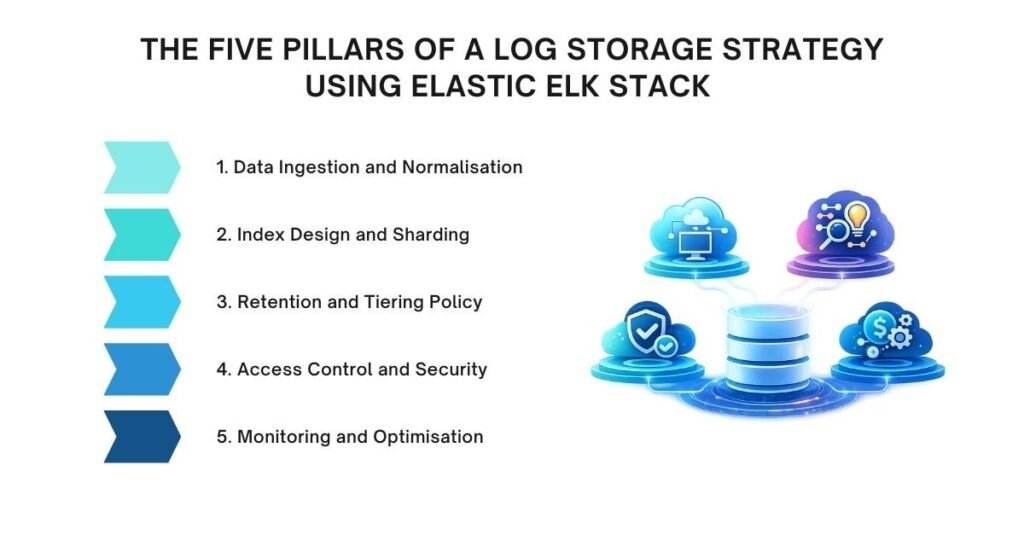
1. Data Ingestion and Normalisation
Collect logs from all relevant sources—servers, containers, cloud services, firewalls, endpoints—and normalise them early in the pipeline using Logstash or Beats. Consistent structure ensures query reliability later.
2. Index Design and Sharding
Define clear indexing policies. Avoid a single monolithic index. Instead, segment by environment, data type, or time period. Proper sharding improves performance and simplifies lifecycle management.
3. Retention and Tiering Policy
Use Elastic’s ILM to automate movement between hot, warm, cold, and frozen storage tiers. Balance regulatory requirements with cost realities.
4. Access Control and Security
Secure the data. Apply role-based access controls within Kibana and Elasticsearch to prevent unauthorised queries. Audit access patterns regularly.
5. Monitoring and Optimisation
Treat the ELK stack itself as a living system. Monitor index size, query latency, and ingestion rates. Tune configurations before performance issues surface.
Managing Growth Without Losing Control
Log data rarely shrinks. Once collection starts, it expands relentlessly as new systems come online and applications generate more telemetry. The challenge isn’t only about where to store it – it’s about how to preserve query performance while the volume multiplies.
Elasticsearch handles scale horizontally. Adding nodes to a cluster increases both capacity and speed. Still, scaling must be deliberate. Without careful index management, clusters can become heavy and unresponsive. Partitioning by time (daily or weekly indices) and applying ILM rules keeps this growth under control.
Another subtle challenge is data variety. As cloud workloads and microservices generate JSON, metrics, and traces, the definition of a “log” keeps stretching. ELK’s schema flexibility helps here, allowing teams to blend structured and semi-structured data without rewriting ingestion rules.
For long-term archives, Elastic’s frozen tier—or integration with object storage like AWS S3—offers an efficient compromise. Data can be queried but doesn’t occupy expensive disk space. This is where traditional log systems often fall short and force teams to either delete data or pay heavily for cold storage.
Balancing Security and Performance
Security teams often face a trade-off: the more logs they collect, the slower the queries become. ELK reduces this tension through its distributed search architecture. Analysts can run complex queries across vast datasets in seconds, without pre-aggregation.
However, speed should never come at the expense of control. Every query reveals something about the person running it—what they’re investigating, what data they can see, and where the system is most sensitive. Elasticsearch’s fine-grained access controls and audit logging features make it possible to maintain strong governance even in large environments.
Encryption—both at rest and in transit—remains essential. So does index-level access restriction. Many organisations underestimate how much sensitive information sits in plain logs: API tokens, usernames, IP mappings, even fragments of application code. Protecting log data deserves the same rigour as protecting production databases.
Cost Optimisation Through Smart Retention
Storage cost creeps up silently. Teams often realise too late that their Elasticsearch cluster has doubled in size because they never defined expiry rules. The trick lies in aligning retention policies with real operational need.
- Critical security logs (authentication events, firewall data, audit trails) may need to stay for a year or more.
- Application performance logs can often rotate after 90 days.
- Debug and development logs may not need storage beyond a week.
ILM policies automate these timelines. When data ages, it transitions to slower tiers or gets deleted safely. Combined with snapshot repositories in S3 or Azure Blob Storage, this method offers both resilience and cost predictability.
The balance is not about how much to keep—it’s about how fast you can retrieve what matters when something goes wrong.
Integrating Log Storage with Broader Security Objectives
A good log storage strategy using elastic ELK stack doesn’t live in isolation. It supports threat detection, compliance, and incident response. ELK integrates well with Elastic SIEM, enabling teams to layer detections and visualisations directly on top of stored data.
This convergence of storage and analytics means no more separate pipelines for monitoring versus investigation. The same indexed data can power dashboards for uptime metrics in the morning and forensic timelines by evening.
Integration also matters at the automation layer. Tools like Elastic Agent or Filebeat simplify ingestion, while APIs allow orchestration with security automation platforms. The result is not just visibility—but operational fluidity.
Conclusion
Logs are only as useful as the structure around them. Elastic’s ELK stack brings that structure within reach, turning scattered log files into a unified, scalable and searchable data foundation. When implemented thoughtfully, it delivers more than compliance—it becomes an operational asset.
A sound log storage strategy should never rely on guesswork. It should align with real investigative habits, regulatory obligations, and growth patterns. The ELK stack offers the flexibility to adapt all three without compromise.
CyberNX provides Elastic Stack consulting services that can help organisations maximise their ELK investments. Their experienced team makes sure to provide quick implementation and follow best practices. It refines the capabilities of the Elastic Stack to help you achieve a better return on investment.
In an environment where every second of visibility counts, getting the foundations right is no longer optional. It’s strategic.
