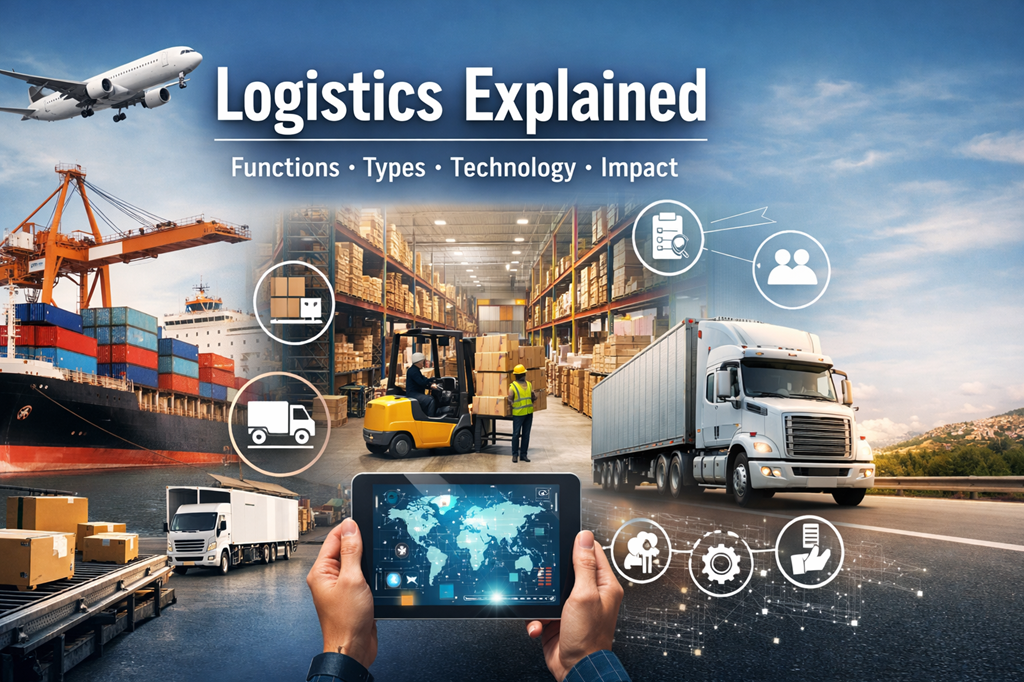
Logistics is the strategic coordination of transporting, storing, and handling goods from origin to consumption. It matters because it keeps supply chains efficient, costs under control, and products available when people need them. Without this coordination, modern economies would slow down quickly.
At a practical level, it connects manufacturers, distributors, and consumers through planned movement and organized storage. At a broader level, it supports global trade, healthcare access, food security, and online commerce. Because of this, it influences both economic stability and daily life.
Well-managed systems reduce delays, prevent waste, and protect service quality. When coordination works smoothly, customers barely notice it. However, when it breaks down, shortages and disruptions become visible almost immediately.
Today, global companies such as UPS, FedEx, and C.H. Robinson play a major role by operating large networks that combine operational expertise with data-driven planning.
How Logistics Supports the Supply Chain
The supply chain describes the full journey of a product, from raw materials to final use. Logistics focuses on execution inside that journey. It controls how goods move, where they pause, and how long each stage takes.
Because these activities touch every phase, performance directly affects production schedules, pricing stability, and customer trust. As a result, organizations treat this function as both an operational requirement and a strategic advantage.
Core Functions Explained Clearly
Transportation Management
Transportation moves goods through road, rail, sea, and air networks. Each mode offers a different balance of speed, capacity, and cost. Therefore, planners select routes and carriers based on urgency, distance, and risk.
Effective planning reduces delays while keeping expenses predictable.
Warehousing and Storage
Warehousing provides secure, organized space between movements. Modern facilities use layout planning, scanning systems, and automation to improve accuracy.
Well-managed storage reduces damage, limits inventory loss, and supports faster order fulfillment.
Inventory Management
Inventory management decides how much stock to hold and where to position it. Excess stock ties up capital, while shortages create missed demand.
Through forecasting and data analysis, teams balance availability with financial efficiency.
Packaging and Handling
Packaging protects goods and enables safe handling. It must align with transport conditions, regulatory standards, and sustainability goals.
Thoughtful packaging lowers waste while preventing transit damage.
Main Types of Logistics in Practice
Procurement Logistics
This type manages the movement of raw materials and components from suppliers to manufacturers. Reliability matters here because delays can halt production lines.
Clear coordination with suppliers reduces disruption risk.
Manufacturing Logistics
Manufacturing support ensures materials arrive exactly when needed on the production floor. This timing minimizes idle time and supports lean operations.
As production complexity increases, precise coordination becomes more important.
Distribution Logistics
Distribution delivers finished goods to retailers, wholesalers, or end customers. Because customers interact directly with this stage, it strongly shapes brand perception.
The growth of e-commerce has raised expectations for speed and transparency.
Reverse Logistics
Reverse operations handle returns, repairs, recycling, and disposal. Although often underestimated, they play a key role in sustainability and customer satisfaction.
Efficient recovery processes reduce costs and environmental impact.
Technology Shaping Modern Logistics
Digital tools now guide most movement and storage decisions. Real-time tracking improves shipment visibility. Predictive analytics supports demand planning. Automation accelerates billing and compliance tasks.
AI-driven platforms analyze shipping data to reduce errors and control costs. For example, Lojistic focuses on freight auditing and shipping cost analytics, while Logisth.AI automates accounting and financial document workflows.
Despite these advances, human expertise remains essential. Technology supports decisions, but experienced professionals manage exceptions and relationships.
The Role of Logisticians Today
Logisticians analyze, coordinate, and optimize networks of suppliers, carriers, and storage facilities. Their work blends operational knowledge with data interpretation and communication skills.
As of 2024, professionals in this field in the United States earn a median salary of about $77,000, depending on industry and experience. This reflects the growing strategic value of the role.
As global supply networks grow more complex, demand for skilled coordinators continues to rise.
Commonly Confused Terms Clarified
Lojistic
A platform designed for shipping cost management, freight auditing, and analytics.
Logisth.AI
An AI solution that automates accounting and document management within logistics operations.
Logistix People
A firm specializing in outsourced warehousing and fulfillment services.
Understanding these distinctions helps separate software platforms from service providers.
Why Logistics Matters Beyond Business
Efficient coordination supports more than commerce. It enables healthcare delivery, disaster response, and food distribution. During emergencies, reliable systems determine how quickly assistance reaches communities.
At a national level, strong infrastructure improves trade competitiveness and economic resilience. Countries with efficient networks attract investment and expand exports more easily.
Because of this, logistics affects quality of life as much as profitability.
The Future Direction of Logistics
This field continues to evolve toward smarter, cleaner, and more resilient systems. Automation, data sharing, and sustainability goals already influence planning decisions.
Yet the core purpose remains unchanged. Logistics connects people, products, and places through precision and trust.
When it works well, it stays quietly in the background. When it fails, its importance becomes immediately clear.
👉 Read more. Learn deeper. Think smarter with Ameisenhardt.