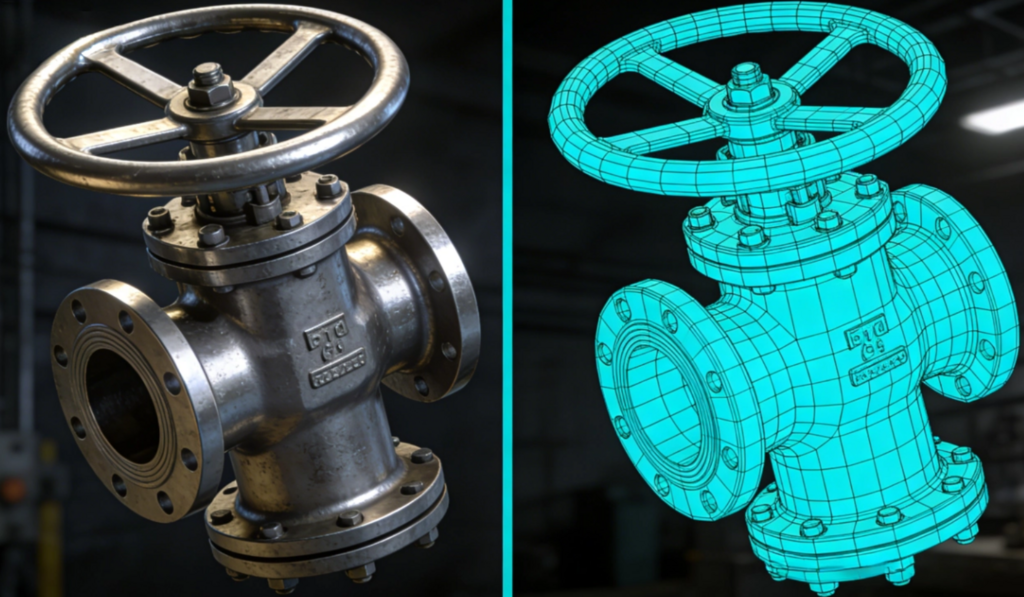
In the context of Industry 4.0, the rapid digitization of physical components has become a core requirement for digital twin integration and PLM (Product Lifecycle Management) workflows. However, a significant gap remains between visual 3D reconstruction and functional engineering geometry. Most generative tools produce “loose” meshes—unstructured triangle clouds that lack the mathematical coherence required for downstream engineering applications.
For professionals, the transition toward industrial-grade 3D mesh generation is not about aesthetic appeal, but about structural interoperability.
The Limitation of Unstructured Triangulation
Traditional 3D reconstruction often results in “dirty” topology: a dense, irregular mesh of triangles that creates significant artifacts during UV unwrapping or simulation. In an industrial environment, these models are essentially dead-end assets. They cannot be easily modified in CAD software, and they perform poorly in real-time visualization engines used for factory floor monitoring.
Effective engineering assets require predictable edge loops and logical surface flow. Without these, the time saved during the automated generation phase is lost during the manual “re-topology” phase, where a technician must rebuild the model from scratch to make it usable.
Standardizing the Output: Quad-Dominant Topology
The primary benchmark for technical 3D assets is the presence of quad-dominant topology. This structure allows for superior subdivision, smoother surface shading, and, most importantly, better compatibility with parametric modeling tools.
Neural4D addresses this requirement by implementing a reconstruction engine specifically tuned for geometric integrity. Rather than producing a raw point cloud, the system generates a structured mesh in approximately 90 seconds. This output adheres to professional standards by prioritizing quads over triangles, ensuring that the model maintains its volume and surface detail when imported into secondary engineering suites or simulation environments.
Streamlining the Digital Twin Pipeline
The utility of high-fidelity AI generation becomes evident when applied to large-scale digitization projects. For an organization maintaining a catalog of thousands of mechanical parts, manual modeling is an impossibility.
By utilizing batch inference, companies can automate the conversion of 2D technical photography into 3D assets. Because the meshes generated are of industrial grade, they can be immediately deployed into AR-assisted maintenance manuals or integrated into broader digital twin ecosystems without the need for a “cleanup” stage. This level of automation shifts 3D modeling from a specialized craft to a scalable industrial utility.
Conclusion: Geometric Precision as a Business Requirement
As engineering firms continue to move toward fully virtualized development cycles, the quality of the underlying 3D data becomes a critical performance factor. Choosing a generation standard like Neural4D, which respects technical topology requirements, is essential for long-term interoperability. In 2026, the value of an AI tool is defined by the cleanliness of its output and its ability to fit seamlessly into a professional engineering pipeline.