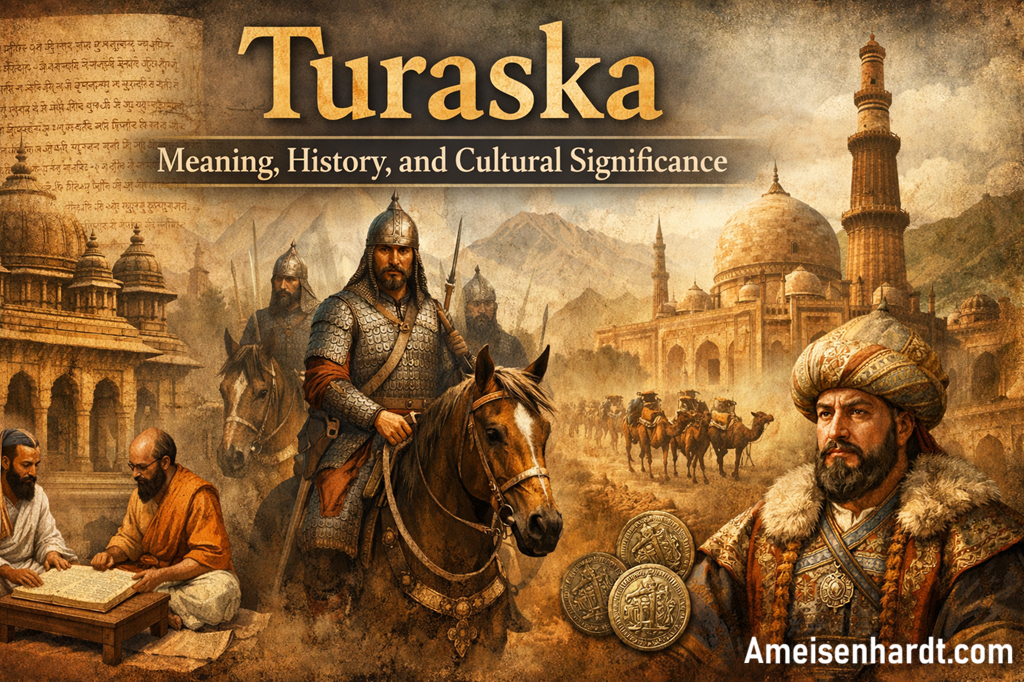
Turaska is a historical term found in ancient Sanskrit and South Asian texts. It was used to describe people from Central Asia, especially Turkic groups, who interacted with the Indian subcontinent through migration, trade, and political activity.
Over time, the meaning of Turaska changed. It began as a general word for outsiders and later became linked with Turkic rulers, cultural exchange, and historical transformation. Today, scholars use it to understand how different cultures met and influenced each other.
What Does Turaska Mean?
Turaska is not a country or a modern identity. It is a historical label.
Ancient writers used it to describe people who came from outside their cultural world, mainly from the northwest regions beyond the Indian subcontinent.
Simple Understanding
| Aspect | Explanation |
|---|---|
| Definition | A term for Central Asian or Turkic people |
| Origin | Sanskrit language |
| Usage | Describing foreign groups |
| Modern context | Used in history and research |
In simple words, Turaska shows how people in the past understood and described outsiders.
Origin and Etymology of the Word
The word Turaska developed as languages changed over time.
It is closely related to the word Turk. In Sanskrit texts, similar forms appear, such as Turushka or Turuṣka.
When people from different regions meet, they often change names to match their own language. That is how Turaska likely formed.
This word became more common when contact between South Asia and Central Asia increased, especially through trade and movement of people.
Turaska in Ancient Texts
Turaska appears in several classical writings.
Where It Is Found
- Puranas
- Mahabharata
- Historical inscriptions
- Court poetry
In these texts, the term described:
- Foreign warriors
- Traders and travelers
- Groups outside the local cultural system
Sometimes the word was neutral. In other cases, it reflected political or cultural differences. Still, its main role was descriptive, not fixed or rigid.
Historical Background and Real World Context
To understand Turaska clearly, we need to look at history.
Key Historical Factors
- Movement of Central Asian groups into South Asia
- Trade routes connecting different regions
- Political expansion by Turkic dynasties
During the medieval period, the term became more closely linked with:
- Ghaznavid rulers
- Delhi Sultanate
- Early Mughal influence
At this stage, Turaska sometimes represented not only outsiders but also powerful rulers and political systems.
How the Meaning Changed Over Time
The meaning of Turaska did not stay the same. It changed with history.
Early Stage
- A general term for outsiders
- Based on geography and culture
Middle Stage
- Linked with Central Asian and Turkic groups
- Connected with military and political roles
Later Stage
- Used in academic and historical discussions
- Seen as a sign of cultural interaction
This change shows how language grows and adapts with human experience.
Cultural and Social Impact
Turaska reflects a deeper story of cultural exchange.
When people from different regions met, they shared ideas, skills, and traditions.
Areas Influenced
- Architecture and building styles
- Art and design
- Systems of governance
- Social customs
These changes did not happen in isolation. They developed through continuous interaction between cultures.
Linguistic Importance
Turaska is part of a group of related words.
Related Terms
- Turushka
- Turka
- Turk
These variations show how the same idea appears in different languages.
They also show how people tried to describe new groups using familiar language patterns.
Turaska as a Symbol of Cultural Connection
Beyond its literal meaning, Turaska also carries a broader idea.
It represents:
- Movement of people
- Exchange of cultures
- Blending of identities
Some modern thinkers see it as a symbol of how societies grow through connection and adaptation. This is an interpretation, not a fixed historical fact.
Common Misunderstandings
Many people misunderstand Turaska. Let us clarify a few points.
Important Facts
- It is not a place or country
- It does not refer to one single group
- Its meaning changed over time
- It is mainly used in academic study today
Understanding these points helps avoid confusion.
Why Turaska Still Matters Today
Turaska remains important because it helps us understand:
- How cultures interact and influence each other
- How language reflects historical events
- How identities evolve over time
It gives a simple but powerful insight. Human history is shaped by movement, connection, and exchange.
Conclusion
Turaska is more than an old historical word. It is a window into the past.
It shows how people from different regions met, interacted, and influenced each other. Its meaning changed over time, but its importance stayed strong.
When we study Turaska, we see a deeper truth. Human history is not separate stories. It is a shared journey built through connection.
That is why Turaska still matters. It reminds us that cultures grow when they meet, learn, and evolve together.