
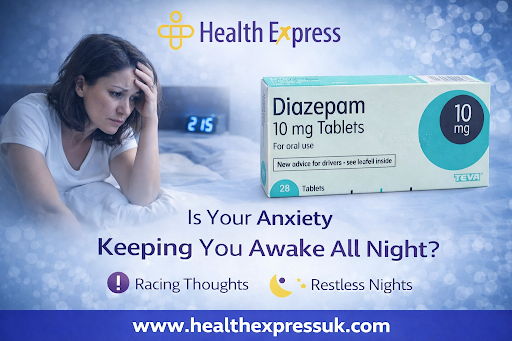
Anxiety has a way of getting louder when everything else around is quiet. A lot of people find out that worries they carry away during the day seem to leap up at night and turn sleep into an arduous task. Repeating thoughts, a tensed-up body, and sleeping together is just out of reach; henceforth, people naturally turn to thoughts of treatment options, including pondering solutions for anxiety meds UK.
Sleep and anxiety form a powerful interplay with each other. The less you sleep, the more sensitive your nervous system becomes, and, conversely, the more sensitive your nervous system is, the harder it becomes to gather yourself for sleep.
Why Anxiety Becomes Stronger at Night
During the day, distractions help to drown out the overlay of anxious thoughts. Work, discussions, and the things of everyday life would help steal the attention. Now at nighttime, these distractions lose their hold. The still active brain turns in on itself. Small concerns now appear many, simply because there is nothing else to distract attention away.
Apart from that, the body is made to stay in an alert state by anxiousness. The heart rate can stay elevated, muscles would remain tight, and shallow breathing remains. These are part and parcel of the body’s natural stress response, but they are not compatible with deep, restorative sleep.
Over the long run, nights spent fitfully may result in folks looking into different ways of coping that can range from relaxation techniques to professional treatment, which, of course, would involve information about anxiety meds uk.
The Role of Medication in Sleep and Anxiety
Undoubtedly, for some individuals, the improvement of insomnia demands the effective management of anxiety first. Physical tension and racing thoughts can be too overwhelming, resulting from the relaxation response alone. At times, a doctor may prescribe medications specifically to calm the nervous system and get a patient to sleep.
In a clinical context, one such used example is diazepam for sleep. These particular medicines enhance the effect of calming neurotransmitters in the brain. Through the reduction in muscle tension, the progress of mental stillness is reached, which helps to alleviate the bothersome mental activity that prevents a person from falling asleep.
In most cases, treatments such as diazepam for sleep are developed within a broader framework for recovery rather than as a solution to be used in the long haul. Aspects of recovery that must be addressed include reducing stress, practicing good sleep hygiene, and learning coping styles.
Understanding How Anxiety Disrupts Sleep Cycles
Sleep does come in different stages, such as light sleep, deep sleep, and rapid eye movement (REM) sleep. The sleep cycle itself will be affected by anxiety through increased nighttime arousals and reduced deep-sleep-wake times.
Even though somebody actually believes that he or she has slept for a good number of hours, a fragmented sleep may render them fatigued on the following day. Fatigue can, in turn, bring about more irritability and heightened anxiety-like thoughts, hence strengthening the vicious circle.
In this quest to break such continuity, one may get to know anxiety meds uk from medications to cognitive-behavioural therapy, mindfulness programs, or breathing exercises.
Safety and Awareness With Sleep Medications
Any medication that affects the nervous system requires careful discussion. Drowsiness, slow reflexes, and even the possibility of being groggy or tired the next day are unfortunately possible with some therapeutic approaches for the induction of sleep. Therefore, it is important to schedule, administer, and follow the guidelines of a medical professional.
Discussion of the use of diazepam for sleep always implies a need for short-term use with close observation because the body can become habituated to a sedative over time. The idea is to stabilize sleep long enough so that healthier routines and coping strategies can take hold.
And there are environmental factors to be considered. Cutting down on caffeine, lessening screen exposure prior to turning out lights, and maintaining consistency in bedtimes can all be of substantial importance in testing optimal results combined with medical treatment.
The Psychological Side of Nighttime Anxiety
Anxiety at night isn’t just about chemical or physical processes. Anticipation also plays a role. After several restless nights, people start worrying about sleep itself. This goes back to the fear of performing well at bedtime, where the fear of not being able to sleep becomes another stumbling block to rest.
Interventions like relaxation can disrupt this chain of events; slowing down one’s regular breathing, progressive muscle relaxation, or guided imagery can reassure the nervous system that it is safe to go down for some rest. Although these strategies sound plain, they might still help diminish night anxiety.
There is a considerable number of people who consider other resources for help; for example, reading about the use of anxiety meds uk. Such persons usually claim that combining these methods with guidance from soft professionals works better than any single strategy.
Building Habits That Support Restful Sleep
On the other hand, proper regularity of the timings of going to sleep and getting up ensures the running of the body clock optimally. Intensive physical activity during the day usually has a boomerang effect on the quality of sleep at night, while fatty and heavy meals or too much excitement late into the night often interfere with rest.
Creating the right sleep environment is as important as anything else. A dark, quiet, comfortably cool room signals the brain that it is time to slow down. Small changes related to light, noise, and even bedtime habits will definitely work wonders for sound sleep in the long term.
In the event that it determines otherwise, in certain circumstances, a medication like diazepam for sleep may provide brief support. However, in general, only the combination of medical care with those routine habits reaps good results in the final analysis.
A Balanced Perspective
Anxiety and insomnia are closely connected, and one can affect the other. At least one would require patience in order to deal with them properly. We must regard the mind-body interactions, mood, and anxiety closely.
Details on anxiety meds uk can provide some useful insights into the available treatments, but drugs always constitute only a partial treatment. Equally important are therapeutic modalities, a healthy lifestyle, and reasonable expectations on the part of a person about overcoming a consistent fresh sleep to return.
