
At A Glance
- Canteens need regular door lock replacements due to wear and tear and staff turnover
- Learning how to replace door locks for your staff-only areas is a cost-effective skill to have
- Use this quick and easy-to-follow guide for the basics on lock cylinder replacement
- This guide focuses primarily on doorway barrel locks, not cabinetry locks, etc.
When in charge of a canteen, it’s important to learn how to replace door lock components. Your maintenance team should be able to replace lock parts, including the barrel, independently. Due to high turnover in canteens, it’s important to ensure each lock cylinder is replaced. In this guide, backed by advice from Multipointlocks, we’ll show you how to get started.
Regular lock replacements could cover various parts of your canteen. Most of the time, it will involve replacing internal doors – such as the door separating the staff area of the canteen from the eating areas. However, it could also include replacing a door lock barrel in a storage space or cupboard.
While barrel locks for doors and storage spaces differ slightly, we’ll give you a rough idea of where to start. Use this information as a starting point to learn the basics of replacing door lock mechanisms during periods of high staff turnover.
Why Canteen Kitchens Need Regular Lock Replacements
There are several reasons why, as a canteen manager, you may need to invest in new locks. The main reasons include:
- Wear and tear. Canteen doors and cabinet spaces are opened more often than household doors. As such, the locks undergo more wear and tear than a traditional lock would.
- Vandalism. Sadly, canteens can be common targets for vandals looking to help themselves to your stock. That could result in lock mechanisms and cylinder locks being broken during the break-in.
- Staff turnover. When staff move on, especially senior management who had access to the canteen keys, it makes sense to replace locks. You never know if they had a spare key cut.
Turnover and regular usage all contribute to the need for routine replacements of barrel locks. There are also conditions: high humidity and regular moisture in the air in a canteen, due to the cooking equipment running all day, which can lead to extra stress and wear-and-tear on the lock mechanisms.
Steps For Replacing A Barrel Lock In A Canteen Kitchen
Replacing a barrel lock is relatively simple. In this guide, we’ll focus on replacing door locks rather than barrel locks used for cabinetry or storage spaces. However, there will be some crossover. If you wish to replace a barrel lock for a canteen kitchen door, such as for staff-only areas, you need to do the following:
Gather Your Tools
To start with, you’re going to need one of a few tools. To start with, we recommend you find:
- A screwdriver set that contains both flathead and Philips head screwdrivers
- A new replacement barrel of a lock that is the same size as your old lock
- The key that you use to lock or unlock your current lock cylinder
For most barrel lock replacements, this should be enough to get you started. You may also wish to get a measuring tape, though, so you can make sure your replacement lock cylinder is the right size. Replacing the barrel of a lock with a larger or smaller cylinder is not recommended. If you need to do this, it often makes sense to replace the lock mechanism in its entirety instead.
Getting Started
First and foremost, you should verify that your replacement cylinder lock is a perfect match for the old lock mechanism. You’ll need to verify that the new lock’s size, profile, and security rating are identical. For the security rating, you may even wish to go higher – never lower.
Removing The Old Lock
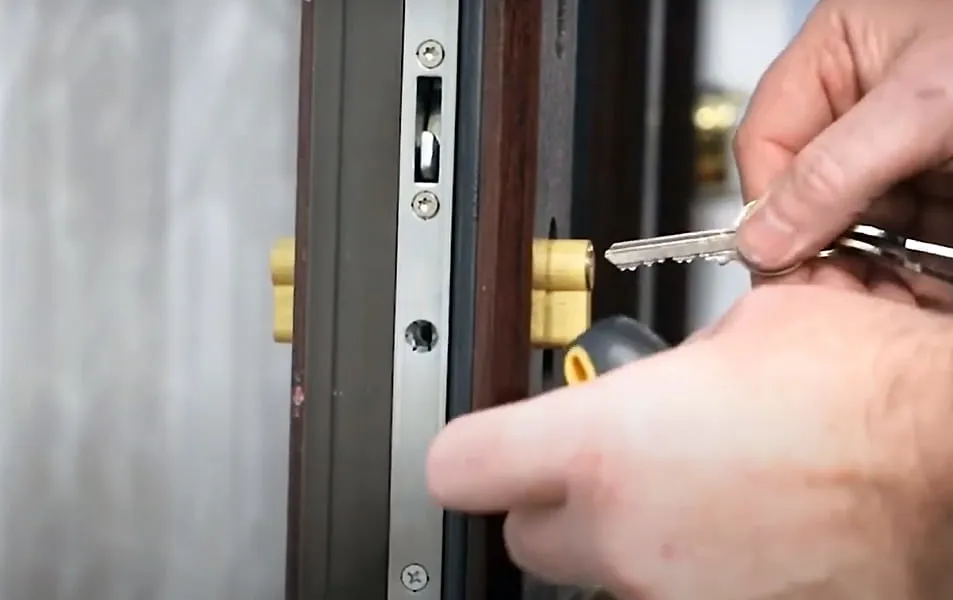
Start by removing the fixing screw from your lock mechanism. This is usually found on the side of the door, normally just underneath where the door latch sticks out. You are looking for a small screw. Once you find this screw, remove it – this should make the lock mechanism removable.
Next, insert the key for your current lock barrel into the lock mechanism. Now, turn this 10 to 15 degrees; this should align the cam and make sure the lock cylinder becomes removable. Once you get this position, hold the key in place with the lock slightly turned and then gently tug on the old barrel of a lock. With a little wiggling and some force, it should come out with relative ease.
You should now have a lock mechanism with no barrel. If you have not yet bought a replacement lock cylinder, measure the current barrel. Then, look for an identically sized replacement. Most sizes are fairly standard, so finding a suitable replacement should be easy.
Installing The New Barrel Of A Lock
Insert the key provided with your replacement model. Turn this slightly, as you did above, to prepare the cams and make sure everything lines up. Now, insert the new cylinder into the original housing and slide it in gently. Avoid any kind of extreme force; if it needs to be forced into place, it’s probably not the right size. A correctly sized replacement should slide in seamlessly.
With the lock cylinder in place, reinstall the fixing screw we mentioned above. This secures the lock in position. With the main bulk of the job done, the only thing left to do is to re-fit anything that you removed beforehand – handles, knobs, or door covers.
Finally, test our your new barrel of a lock. Lock and unlock the door several times, doing so from both sides. Does everything work? Does the lock engage and disengage smoothly?
If you run into any problems, start again from scratch and try again. Try applying some silicone-based lubricant to the new lock, as well, to see if that helps smooth the operation slightly.
Keep Staff-Only Areas Secure
With the above guide, you should now have the basics for replacing door lock mechanisms. Now, this is just the basics: if you have more advanced door locks, such as smart locks, it won’t be as easy.
Our advice would be to try to replace the door lock yourself. Follow the above steps and take your time. If you are unable to make the change work on your own, hire a professional and watch their process closely. Learn from what you may have done wrong, and you can then find it easy to replace door locks in your staff-only doorways and entrances.
Keeping your canteen properly compartmentalised is important, and this should make the process a little easier for you. Good luck with replacing door locks in your canteen!
