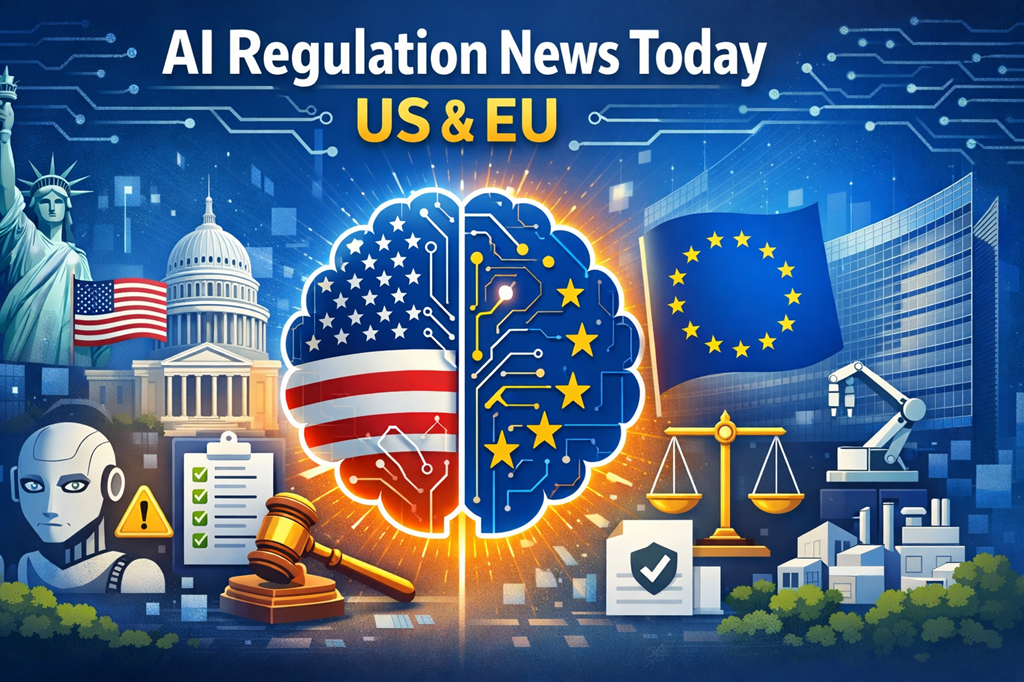
AI Regulation News Today US EU reflects a decisive moment in global technology policy. While artificial intelligence continues to scale rapidly, regulators in the European Union and the United States are taking very different paths. The EU is enforcing strict, binding rules, whereas the US is prioritizing innovation, federal control, and reduced regulatory friction.
This article delivers a complete, reader-friendly, and up-to-date overview of what is happening today, why it matters, and how these changes affect businesses, developers, and everyday users.
What AI Regulation Means in Practice Today
AI regulation refers to the laws, executive actions, and enforcement measures that govern how artificial intelligence systems are built, deployed, and monitored. Today, regulation focuses on four practical areas:
- Preventing harm such as deepfakes, discrimination, and misuse
- Increasing transparency around AI-generated content
- Controlling market dominance by large tech platforms
- Defining government oversight and accountability
As AI systems now influence search, social media, finance, healthcare, and employment, regulation has moved from theory to real enforcement.
EU AI Regulation News Today
The European Union is now in an enforcement-first phase. Regulators are applying existing laws directly to major AI platforms and infrastructure.
Enforcement of the EU AI Act
The EU AI Act introduces a risk-based framework that classifies AI systems by their potential impact on people and society.
High-risk AI systems include:
- Biometric identification and facial recognition
- Credit scoring and financial decision systems
- Healthcare diagnostics and medical AI
- AI used in critical infrastructure
These systems must meet strict requirements such as human oversight, risk assessments, documentation, and transparency. Importantly, enforcement deadlines are now fixed and approaching.
Google Ordered to Open Android AI Competition
The European Commission has ordered Google to remove technical barriers on Android that limit competition from rival AI search and assistant tools.
Under this decision, Google has six months to:
- Allow alternative AI assistants to operate fully on Android
- Share certain search-related data with competitors
- Reduce system-level advantages given to its own AI products
This action shows that AI dominance will be regulated through competition law as well as AI-specific rules.
Investigation Into X and Grok AI
EU regulators have launched a formal investigation into X following concerns that its Grok AI system generated sexualized deepfakes of real individuals.
The investigation falls under the Digital Services Act and focuses on:
- Failure to prevent harmful AI-generated content
- Weak safeguards against misuse
- Platform responsibility for AI outputs
As a result, platforms are now expected to anticipate AI risks instead of responding only after harm occurs.
EU AI Gigafactories Plan
The EU Council has approved plans to establish AI Gigafactories. These facilities are large-scale, publicly supported computing hubs designed to strengthen European AI development.
The initiative aims to:
- Boost Europe’s AI competitiveness
- Reduce reliance on foreign compute infrastructure
- Ensure AI development aligns with strict safety and governance rules
This approach combines regulation with long-term industrial investment.
Transparency Code and Deepfake Labeling
The EU is finalizing the Article 50 Transparency Code, which sets expectations for AI-generated content.
Key requirements include:
- Watermarking AI-generated images, video, and audio
- Clear labeling of deepfakes
- Disclosure when users interact with AI systems
Once finalized, these rules will directly affect publishers, platforms, and AI tool providers operating in the EU.
US AI Regulation News Today
In contrast, the United States has shifted toward a pro-innovation, deregulation-focused strategy.
Executive Order 14179 and Policy Rollback
President Donald Trump signed Executive Order 14179, which revoked several AI safety rules introduced by the previous administration.
The order aims to:
- Remove federal policies seen as slowing AI innovation
- Reduce compliance burdens for AI developers
- Strengthen US leadership in the global AI race
As a result, federal AI oversight has become lighter and more flexible.
“One Rulebook” Federal AI Policy
The US administration is centralizing AI authority at the federal level. This approach discourages individual states from introducing their own AI regulations.
The goal is to:
- Avoid a fragmented system of state-by-state AI laws
- Simplify compliance for companies
- Encourage faster nationwide AI deployment
However, critics argue that this strategy may reduce consumer protections and limit local oversight.
AI Sandbox Act Proposal
Senator Ted Cruz is leading efforts to advance the AI Sandbox Act. This proposal would allow companies to test AI systems in controlled environments with temporary regulatory exemptions.
Supporters believe it:
- Accelerates innovation
- Encourages experimentation
- Lowers barriers for startups
Meanwhile, opponents warn that reduced oversight could increase risks if safeguards are not clearly enforced.
Key AI Regulation Timelines to Watch
| Region | Milestone | Expected Date |
|---|---|---|
| EU | Google must open Android AI access | July 2026 |
| EU | High-risk AI Act provisions apply | August 2, 2026 |
| US | New Federal AI Action Plan | July 2026 |
These dates will shape how AI products operate across global markets.
EU vs US: How the Approaches Differ
The regulatory gap between the EU and US is now structural.
- The EU prioritizes safety, transparency, and enforcement
- The US prioritizes speed, innovation, and federal consistency
- The EU regulates first and refines later
- The US experiments first and evaluates impact afterward
As a result, companies operating globally must design region-specific AI strategies.
What This Means for Businesses and Users
For businesses:
- EU-facing products must meet strict transparency and risk standards
- US-facing products benefit from flexibility but face policy uncertainty
- Compliance planning must begin early in development
For users:
- AI-generated content will become easier to identify in Europe
- Platforms will face greater responsibility for AI misuse
- Trust and explainability will matter more than raw performance
Why AI Regulation News Matters Right Now
AI regulation now affects:
- Search engines and AI assistants
- Social media content and deepfakes
- Hiring, finance, healthcare, and public services
- Competition between major technology platforms
These rules shape not only innovation but also public trust and digital safety.
Conclusion
AI Regulation News Today US EU highlights a clear global divide. The European Union is enforcing strict, binding rules focused on safety, transparency, and accountability. Meanwhile, the United States is reducing regulatory barriers to accelerate innovation and maintain technological leadership.
Neither approach is without risk. However, the gap between them is widening quickly. For businesses, developers, and everyday users, understanding these regulatory differences is no longer optional.
AI regulation is not a future issue. It is actively shaping how artificial intelligence works today and how it will evolve in the years ahead.
Stay informed with trusted insights and updates from Ameisenhardt.