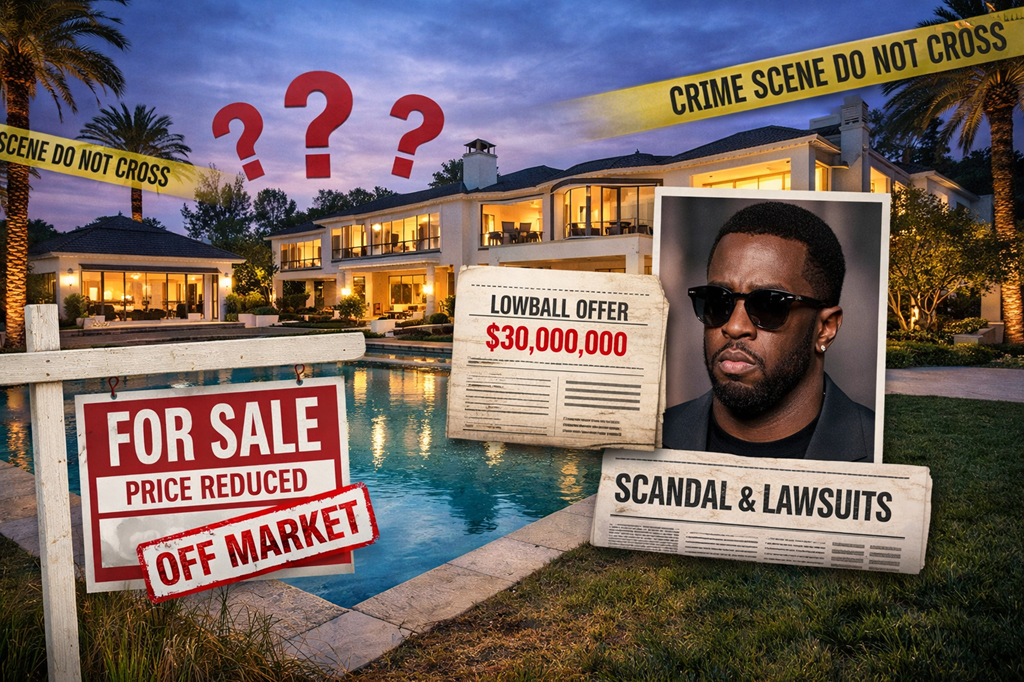
Diddy mansion sale stigma describes how Sean “Diddy” Combs’ $61.5 million Los Angeles estate became difficult to sell because buyers viewed it as socially and reputationally risky. The stigma reduced interest, discouraged agents, triggered a $30 million low offer, and led to the listing being withdrawn in 2026.
Introduction
The Diddy mansion sale stigma has become one of the clearest modern examples of how reputation can overpower real estate fundamentals. The $61.5 million Los Angeles mansion associated with Sean “Diddy” Combs is, by every traditional measure, a premier luxury property. Yet despite its scale, location, and amenities, it struggled to attract serious buyers and was ultimately withdrawn from the market.
This is not a story about flawed architecture or market mispricing alone. It is a story about perception, psychology, and trust, three forces that increasingly shape outcomes in ultra-luxury real estate.
What “Diddy Mansion Sale Stigma” Means in Real Estate
In professional real estate terms, this situation is best described as a stigmatized property. A stigmatized property is one that is psychologically impacted by a widely known event or association, even when the physical condition of the home is pristine.
In this case, the stigma stems from the mansion’s public connection to serious legal allegations and intense media coverage surrounding its owner. While the home itself is not accused of wrongdoing, the story attached to the address has become inseparable from the broader controversy.
For high-end buyers, that story matters as much as square footage.
Why Luxury Buyers Are Especially Sensitive to Stigma
Luxury homes are social assets, not just residences
Ultra-luxury real estate operates under a different logic than standard housing. Buyers at this level are not simply purchasing shelter. They are buying privacy, prestige, and emotional comfort.
As a result, their decision-making includes questions such as:
- Will this home reflect positively on my identity?
- Will hosting guests here feel comfortable?
- Could this address attract unwanted media attention?
- Will resale be complicated in the future?
When any of these answers feel uncertain, buyers often disengage early.
The “No Bragging Rights” Problem
One of the most frequently cited reasons for the mansion’s weak buyer interest is the lack of “bragging rights.”
In luxury markets, bragging rights are not about ego. They are about ease. A luxury home should feel natural to mention, share, and enjoy socially. When a property’s name recognition is tied to controversy rather than admiration, that ease disappears.
Instead of pride, buyers anticipate awkward conversations or silent judgment. Many decide it is easier to look elsewhere.
Negative Association and Buyer Psychology
How public narratives reduce demand
The mansion’s challenges are closely linked to ongoing media coverage of allegations involving sex trafficking and racketeering. Even without final legal outcomes, the volume and persistence of coverage created a lasting narrative.
That narrative introduced several psychological barriers:
- Fear of constant public curiosity
- Anxiety about long-term reputational attachment
- Uncertainty around future resale value
In luxury real estate, uncertainty often does more damage than price.
Why Some Agents Avoid Stigmatized Listings
Professional reputation and risk management
Top-tier real estate agents are highly selective about the listings they publicly represent. Their business depends on trust, discretion, and elite networks.
According to reporting by Yahoo Finance, some agents were hesitant to be publicly associated with the mansion due to the controversy surrounding it. This hesitation matters because luxury transactions are driven less by public listings and more by private introductions and referrals.
When fewer agents are willing to champion a property, the buyer pool narrows quickly.
A Mansion With Every Luxury Feature, Yet Weak Demand
From a physical standpoint, the home offers everything expected at its price level:
- Private home theater
- Guest house accommodations
- Spa-style bathrooms
- Resort-scale pool and outdoor areas
- Prime Los Angeles location
Under normal conditions, these features would generate immediate interest. However, luxury real estate is not sold on amenities alone. Emotional comfort and public perception play an equally powerful role.
Tepid Interest as a Market Signal
Despite its features, buyer engagement reportedly remained low. This lack of momentum is one of the strongest indicators of stigma at work.
In healthy luxury listings, even overpriced homes attract negotiations and counteroffers. In this case, many buyers appeared unwilling to even begin the conversation.
The $30 Million Offer and the “Stigma Discount”
One of the most telling moments in the sale attempt was a reported $30 million offer, roughly half the asking price.
This reflects a well-known phenomenon called a stigma discount. Buyers who are willing to accept reputational risk often demand significant price reductions to compensate for:
- Longer holding periods
- Marketing challenges
- Difficulty reselling later
Price becomes the mechanism used to absorb emotional and reputational discomfort.
Why the Listing Was Withdrawn
By early January 2026, the mansion was reportedly withdrawn from the market following sentencing developments and continued negative publicity.
Delisting in such cases is often a strategic pause, not a defeat. It can:
- Prevent further public price erosion
- Reduce visibility during peak controversy
- Allow time for perception to soften
In ultra-luxury markets, patience can be a powerful tool.
How Long Does Property Stigma Last?
There is no fixed timeline. Some stigmas fade within months. Others persist for years.
Key factors include:
- Intensity of media coverage
- Legal clarity and resolution
- Cultural memory
- Online search visibility
Celebrity-related stigma often lasts longer because digital content, videos, and social commentary remain searchable indefinitely.
Can Stigma Be Reduced or Removed?
Yes, but only with deliberate strategy
Experienced investors and brokers typically rely on a combination of approaches:
1. Time and distance
Allowing the news cycle to cool is often the most effective step.
2. Renovation and redesign
Major physical changes can help buyers psychologically separate the home from its past.
3. Narrative repositioning
Marketing that focuses on architecture, craftsmanship, and lifestyle rather than ownership history can gradually reshape perception.
4. Targeted buyer profiles
Some international buyers or developers may be less influenced by local media narratives, though usually at adjusted pricing.
Expert Context: What Real Estate Authorities Say
Industry definitions support this interpretation. The National Association of Realtors describes stigmatized properties as those affected by psychological impact rather than physical defects, especially when public knowledge influences buyer behavior.
MSN’s real estate analysis further emphasizes that properties carrying “notorious issues” face lingering perception problems even when legally cleared.
Related Media Explanation
For a concise visual breakdown of why the mansion struggled to sell, this short video explains the situation clearly:
Final Thoughts: When a Home Becomes a Headline
The Diddy mansion sale stigma is more than a celebrity real estate headline. It is a real-world lesson in how culture, media, and psychology now shape asset values.
At the highest levels of the housing market, buyers are not just purchasing luxury. They are purchasing peace of mind.
When that peace feels compromised, even a $61.5 million mansion can become very difficult to sell.