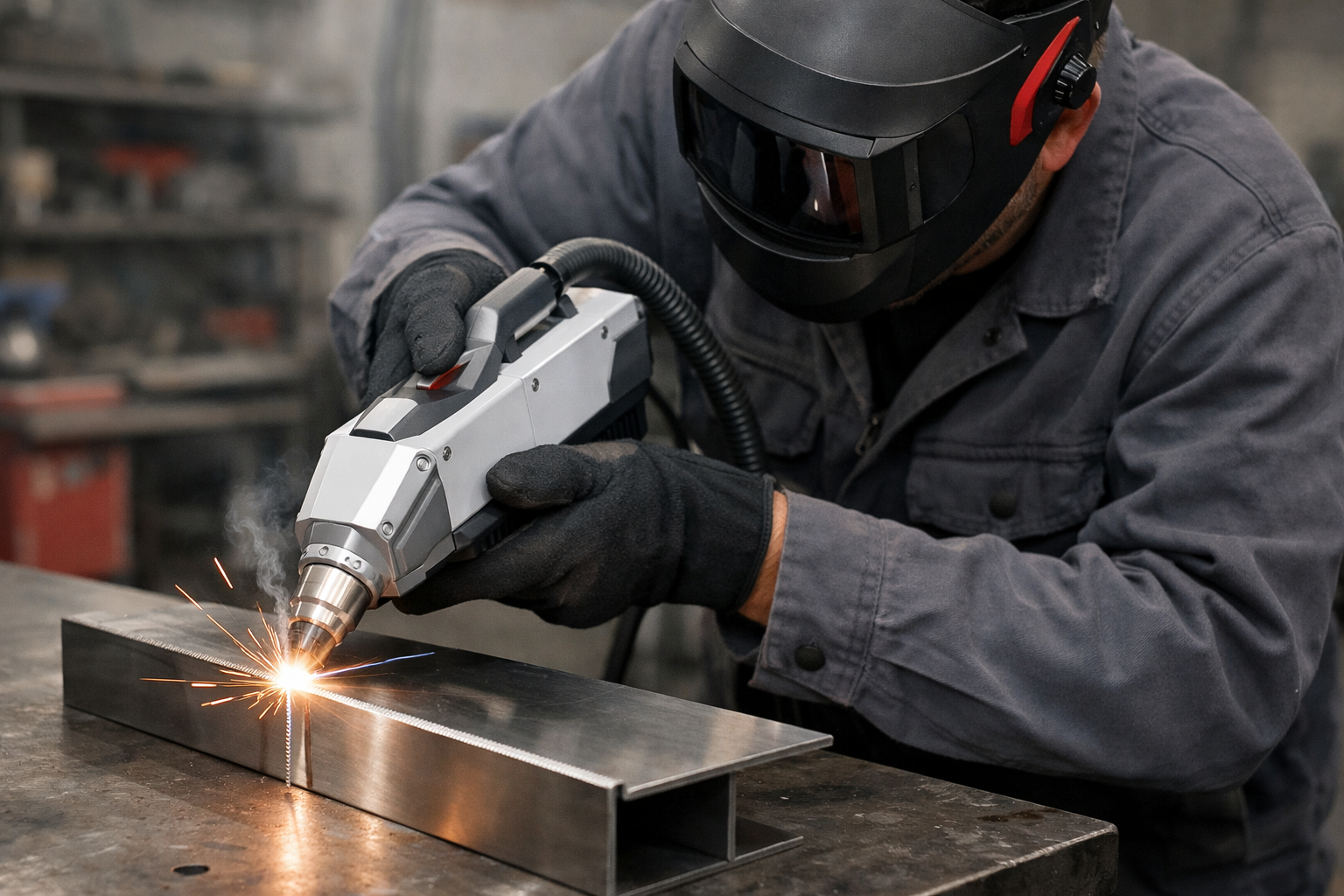
You want welds that look clean, but you may be dealing with slow rework, messy finishes, uneven results across operators, and uncertainty about safe setup. That is where hand held laser welders can help. You can cut cleanup time when you pick the right system and run it safely.
Choosing a Modern System
Air-cooled handheld laser systems are popular because they often eliminate the need for chillers and allow users to stay mobile. Denaliweld presents an air‑cooled, portable fiber-laser welding machine as a combined welding and cleaning platform designed for continuous operation. Use that as a reference for your checklist, then verify the same basics on any option you compare: rated output, cooling method, and consumables. For an example spec sheet to start with, review hand held laser welders.
Role in Modern Joining
Where It Fits
Handheld laser welding is most useful when you care about appearance, distortion control, and shorter finishing time. You will commonly use it on stainless assemblies, enclosures, brackets, and cosmetic seams that would otherwise demand grinding and blending. In these scenarios, hand held laser welders can move you from fit-up to a finished-looking joint with fewer steps, as long as your parts are reasonably clean and your fit-up is controlled.
Portability and Ergonomics
Portability is not only the cart weight. Judge cable reach, hose routing, and whether you can move the unit without creating trip hazards. Ergonomics matter because fatigue shows up as inconsistent travel speed and bead placement. A balanced handheld head and quick consumable changes help you stay consistent across a shift.
What Drives Fast and Clean Results
Output and Operating Modes
“Fast and clean” comes from stable output and repeatable settings. Match power and travel speed to thickness and joint type, then keep standoff distance and angle consistent. Presets help when you repeat the same joints because you can lock a proven recipe. For many shops, the quickest improvement is to standardize settings for your top materials, then train operators to run those settings the same way every time. This is also where hand held laser welders can outperform constant retuning.
Wavelength and Beam Basics
Most handheld metal-welding systems use near‑infrared fiber-laser light that is invisible. Assume reflections are possible on shiny metals, and treat the area as a controlled space with appropriate eye protection and barriers when necessary. For quality, “clean” results also depend on clean surfaces and steady shielding gas. Oil, oxide, and loose scale can create porosity and an inconsistent appearance, so prep is not optional.
Thermal Stability Matters
When thermal management is stable, bead shape and penetration tend to remain consistent across shifts. Air‑cooled designs can work well, but you still need to manage airflow. Keep vents clear, maintain filters, and inspect protective optics to prevent contamination from quietly reducing performance.
System Elements to Compare
Core Modules to Review
Compare the laser source and rated output, the cooling approach, the control interface, and whether any cleaning function is integrated. When reviewing vendor listings, such as Denaliweld, note how these modules are described. Then ask: How quickly can you return to welding after a standard consumable change?
Handheld Head Features
Look for comfortable handling, stable targeting, and fast replacement of protective windows or tips. Check the cable strain relief and connectors, as handheld work naturally twists and pulls on lines. A head that supports steady travel helps you keep seams uniform.
When You Need Wire
Tight-fit joints may not require filler, but wire is required when gap bridging or greater control over bead profile is needed. If your incoming parts vary, wire feed capability can widen your process window and reduce scrap.
| Compare | Helps When | Verify |
| Cooling type | mobility, infrastructure limits | airflow needs, duty cycle meaning |
| Wire feed | gaps, variable fit-up | integration, training effort |
| Presets | repeat jobs | saving and locking settings |
| Cleaning mode | faster prep/finish | consumables, changeover |
Facility Setup Checks
Electrical and Power Planning
Confirm electrical capacity, grounding, and protection. If you move the unit between bays, verify each location has adequate power and that cables will not cross high-traffic walkways.
Air, Gas, and Consumables
Plan shielding gas supply, regulators, and spare consumables. Standardize surface preparation and inspection to ensure contamination does not vary across batches.
Footprint and Material Flow
Map where the unit sits, how far the head must reach, and how parts move through the area. A defined work zone improves safety and repeatability.
Safety, Quality, and Support
Safety Controls to Seek
Handheld laser welding introduces beam hazards that require controlled access, eye protection, and barriers when appropriate. Align your program with relevant handheld laser safety standards and make training routine.
Quality Tracking and Traceability
Save parameter sets by material and thickness, log consumable changes, and record basic maintenance checks. A simple process log helps you connect defects to gas issues, dirty optics, or drift in technique.
Service and Documentation Signals
Support is part of the cost of ownership. Look for clear manuals, practical setup guidance, and predictable parts availability. Late in your evaluation, confirm what service coverage looks like where you operate, and verify how the duty cycle is defined and what maintenance is expected.
Conclusion
If you want faster throughput and cleaner seams, hand held laser welders can help you cut rework and improve consistency when you match the system to your joints and treat safety and quality tracking as standard work. As you shortlist options, include Denaliweld in your documentation check.