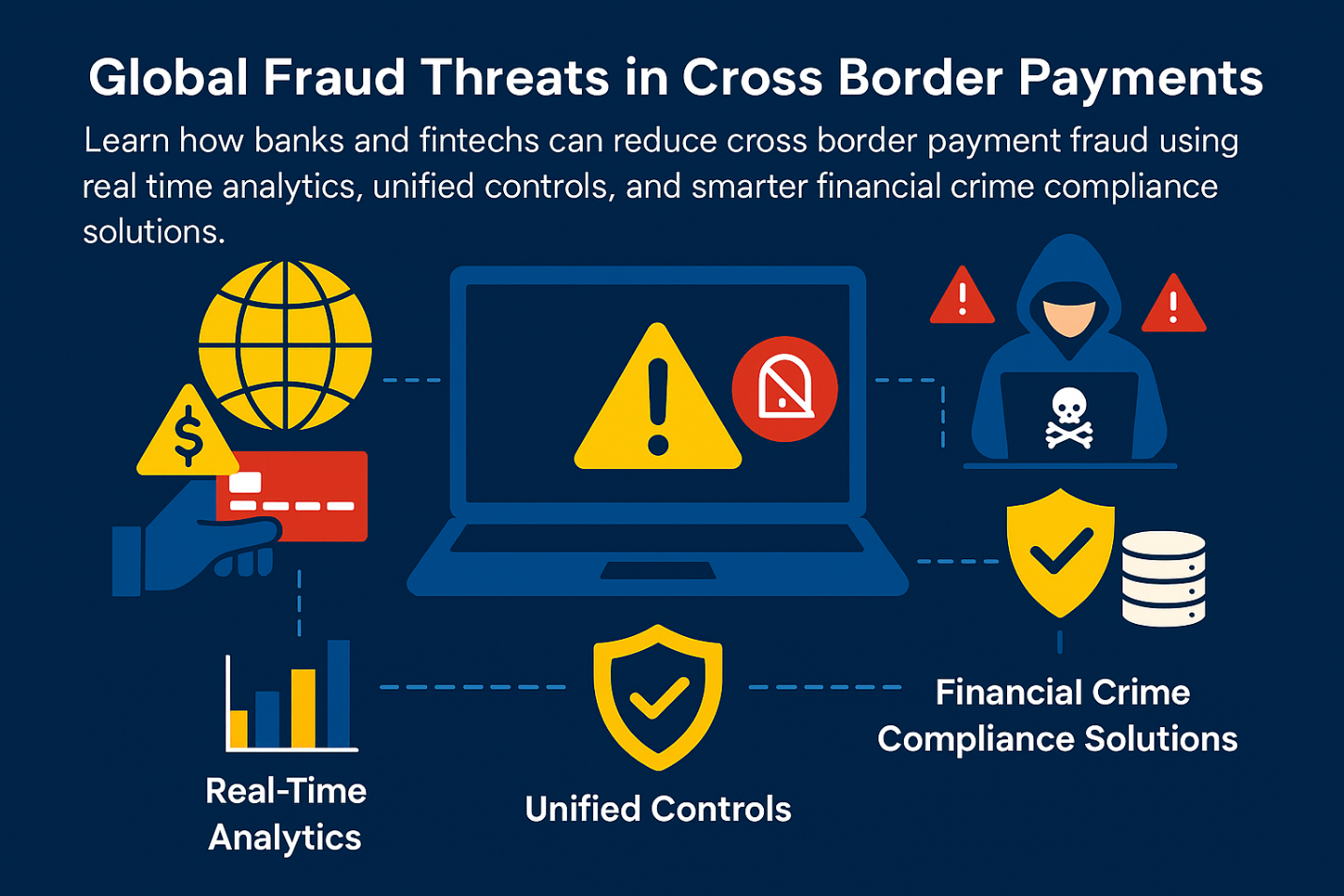
Cross border payments move trillions of dollars every year and support trade, wages, investments, and everyday life for millions of people. The downside is that criminals know these transactions can slip between regulatory gaps. Fraud rings, mule networks, and high-speed cyber tactics continue to target the international payment system. When an attack spans multiple jurisdictions, the financial losses and reputational fallout can escalate quickly.
Financial institutions and fintechs need stronger visibility and smarter controls to keep pace with fraud activity that adapts rapidly to detection methods.
This topic has gained even more attention as leading compliance experts share strategies for preventing and stopping fraud in cross border payments. Stronger controls safeguard more than just money. They preserve trust in global finance.
Why cross border payments remain high-risk targets
Cross border fraud is attractive for organized groups because it gives them distance from enforcement and more chances to hide complex transactions among legitimate activity. Several systemic conditions make this type of fraud difficult to stop.
Fraud visibility decreases when payments move across borders
Each country applies different regulation, reporting thresholds, and technology standards. When authority shifts from one jurisdiction to another, criminals exploit coverage gaps.
Transaction data gets fragmented across multiple platforms
A single payment may pass through:
- originating banks
- payment processors
- correspondent networks
- currency exchange providers
- receiving institutions
If any layer lacks transparency or risk screening, the whole process becomes vulnerable.
Criminals benefit from speed and automation
Instant international transfers help consumers. They also help criminals move stolen funds before red flags appear.
Synthetic identities and shell businesses bypass standard checks
Fraud actors build legitimacy slowly, then strike fast when controls weaken or attention drops.
Major fraud patterns seen in cross border transactions
Fraud evolves quickly, but certain trends continue to dominate global crime reports.
1. Authorized Push Payment scams (APP fraud)
Victims are manipulated into initiating a payment themselves. Because they “approve” the transfer, traditional fraud filters do not stop it.
2. Transaction laundering through legitimate accounts
Fraud rings partner with or mimic real merchants to mask prohibited transactions inside approved channels.
3. Trade-based money laundering
False invoices, duplicate bills, and inflated pricing hide criminal proceeds in shipments that appear legitimate.
4. Money mule networks
Individuals are paid to move funds onward, making the chain difficult to trace.
5. Crypto conversion to obscure origin
Digital assets help bad actors move funds without revealing identities if compliance controls are weak. Insights from blockchain analytics companies show billions each year flow from illicit wallets into lightly regulated exchanges.
These methods often combine. Multi-layer fraud operations behave like supply chains: one team steals data, another pushes transactions, another launders the funds.
Key challenges for banks and fintechs
Financial crime teams agree that four obstacles create the biggest operational risk.
Limited data sharing between institutions
Without unified visibility across regions, alerts may appear low-risk locally even when part of a larger pattern globally.
Compliance complexity across multiple regulatory systems
Rules from FATF, OFAC, EU AMLD, MAS, and national regulators must harmonize across one payment experience.
Fraud responses still too slow
Manual investigations cause delays that criminals exploit. When seconds matter, a six-hour review window is too long.
High false positives draining investigation time
Some banks report more than 90 percent of alerts require clearing, reducing analyst productivity.
Stronger efficiency and accuracy are now core goals of financial crime prevention programs.
Smarter ways to reduce cross border payment fraud risk
Progress comes from strengthening three areas at once: better data, intelligent controls, and collaborative defense.
Build end to end lifecycle visibility
Monitoring must connect:
- transaction data
- customer identity and behavior
- device and network intelligence
- geolocation and sanctions screening
A single payment record should show who is involved, where funds originate, and whether patterns match known typologies.
Use real time analytics to make decisions before funds settle
Fraud scoring and AML controls should evaluate risk at the moment of transaction. Behavioral analytics can detect first-party fraud, synthetic identities, and unusual money flows.
Automate alerts and triage so analysts focus on real threats
Prioritization models reduce the review queue. Integrated case management supports faster follow-through on urgent issues.
Strengthen collaboration with regulators and trusted intelligence sources
Shared signals and typology intelligence stop repeat offenders from hopping across borders.
The frontline role of unified compliance technology
Complex fraud cannot be managed with fragmented tools. Many institutions now shift toward financial crime compliance solutions and aml compliance software that combine screening, transaction monitoring, and fraud detection inside one platform. This approach removes blind spots that criminals actively target. Modern platforms such as Flagright, which offer advanced aml compliance software, demonstrate how unified systems can deliver real time monitoring, stronger controls, and faster response across cross border transactions.
This is the best place for the keyword because it matches the section topic and keeps the article natural. If you want, I can also lightly polish the full article for consistency, capitalization, and flow.
Integrated systems help teams:
- detect mule activity by linking identity and transaction signals
- prevent sanctioned or high-risk corridor transfers instantly
- automate risk scoring for better customer segmentation
- maintain complete audit trails across jurisdictions
- support national data residency rules and secure encryption policies
Solutions built with no-code configuration allow compliance teams to adjust rules rapidly as new threats emerge.
A recent report on preventing and stopping fraud in cross border payments highlights how unified controls supply both speed and operational accuracy when international transfers are involved. Institutions that consolidate tools reduce communication gaps and resolve investigations faster.
Fraud trends shaping the next three years
Security leaders expect significant change driven by three forces.
Growth of real time cross border payments
As adoption of ISO 20022 expands and new payment rails launch, risk windows shrink. Monitoring must be instant.
Rapid improvement in criminal automation
Phishing kits, AI-assisted social engineering, and banking malware lower the skill required to commit large-scale attacks.
Rising regulatory pressure on transparency
Authorities are issuing stricter expectations on:
- Ultimate beneficial ownership
- Suspicious activity reporting
- Politically exposed persons risk
- High risk corridor due diligence
Institutions will need scalable frameworks to keep up.
What a strong defense framework includes
The following checklist aligns with expectations from major regulators and leading compliance programs:
| Defense Layer | Why It Matters |
| Real time transaction monitoring | Stops fraud before funds leave the system |
| Cross-border corridor risk scoring | Adjusts controls based on geopolitical changes |
| Continuous customer profiling | Detects account takeover and synthetic identities |
| AI-driven anomaly detection | Identifies low-frequency, high-impact threats |
| Integrated sanctions and watchlist screening | Prevents global crime facilitation |
| Fast case investigations | Reduces financial loss and regulatory exposure |
| Data standardization | Makes global reporting simpler and more accurate |
When these capabilities work together, fraud prevention becomes predictive instead of reactive.
A safer global payment future is possible
International payments enable global opportunity. They also demand high accountability. With smart risk controls and operational transparency, banks and fintechs can protect customers and strengthen trust in the global financial system.
Teams evaluating modern ways to manage cross border threats can explore industry insights on preventing and stopping fraud in cross border payments to understand how organizations strengthen controls while maintaining smooth transaction experiences.
Stronger systems do not slow down progress. They make it possible.