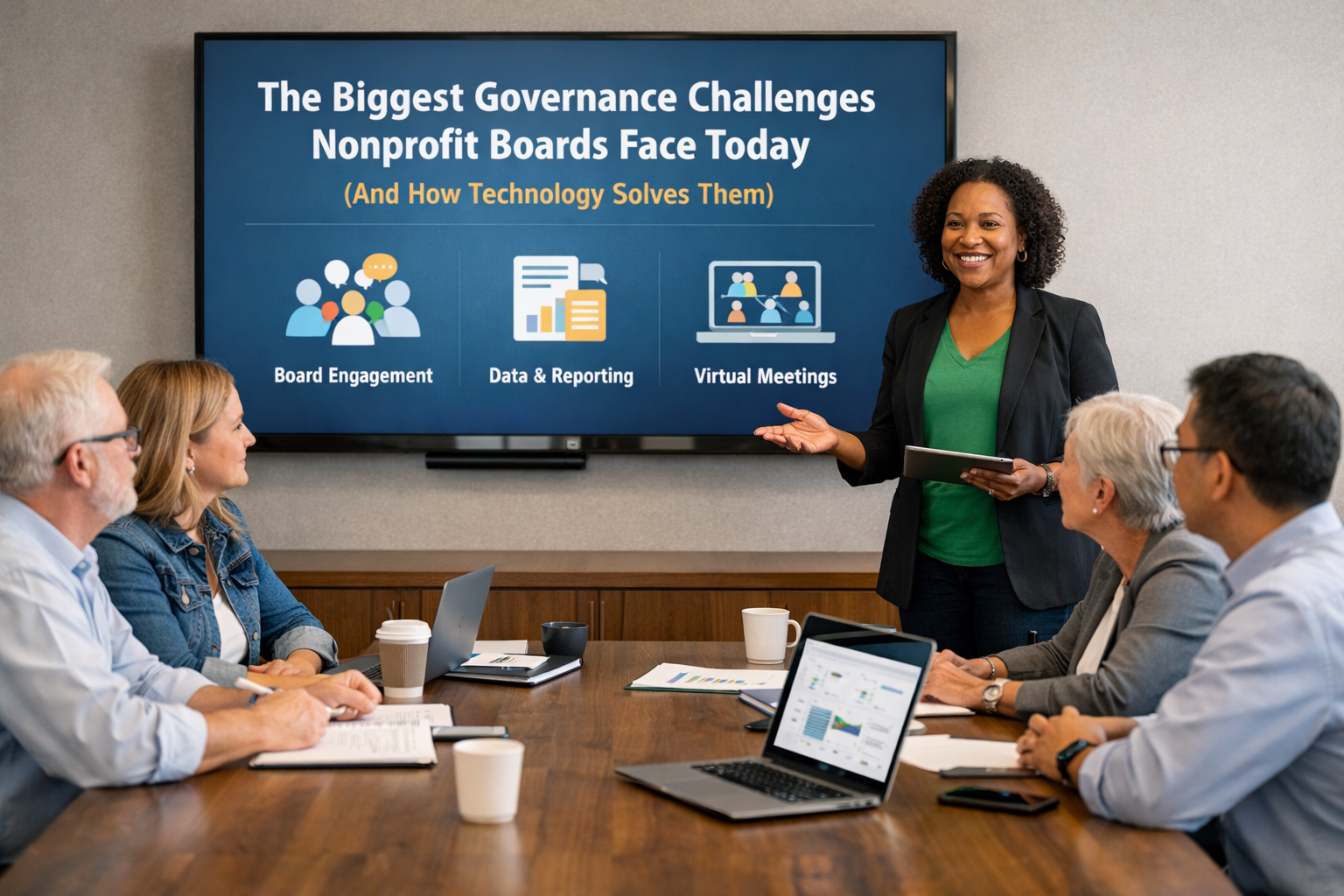
Nonprofit boards carry an enormous amount of responsibility. They set strategic direction, ensure financial accountability, protect the organization’s mission, and maintain the trust of donors, beneficiaries, and the public — often with limited staff support and volunteer directors who are juggling full-time careers.
Yet governance expectations for nonprofits have never been higher. Regulators, funders, and the communities these organizations serve are increasingly demanding transparency, accountability, and demonstrated strategic leadership from boards. For many nonprofits, the gap between what good governance requires and what their current systems can support is widening.
This article examines the most pressing governance challenges nonprofit boards face today — and how the right tools and practices can help boards meet them.
Why Nonprofit Governance Has Become More Complex
The governance landscape for nonprofits has shifted significantly over the past decade. Regulatory frameworks have grown more demanding: state attorneys general, the IRS, and sector-specific funders now expect boards to actively demonstrate oversight — not simply sign off on annual filings.
Donor expectations have evolved in parallel. Major donors and foundations increasingly conduct governance due diligence before committing funding. They want to see evidence of board engagement, transparent decision-making, and documented financial controls. A board that cannot demonstrate these qualities risks losing the confidence — and the grants — it depends on.
At the same time, the strategic demands on nonprofit boards have grown. Boards are being asked to contribute meaningfully to organizational resilience, DEI commitments, risk management, and long-term sustainability planning. These responsibilities require more structured, better-informed board engagement than most traditional governance models were designed to support.
Common Governance Challenges Nonprofit Boards Encounter
Across the nonprofit sector, certain governance challenges appear with remarkable consistency — regardless of organization size, mission, or geography. Understanding them is the first step toward addressing them.
Limited administrative resources. Most nonprofits lack the dedicated governance support that corporate boards take for granted. A single executive director or part-time administrator is often responsible for scheduling meetings, preparing board packs, managing minutes, tracking action items, and coordinating follow-up — all while managing day-to-day operations. When administrative capacity is stretched, governance quality suffers.
Fragmented communication. Board materials distributed across email threads, cloud storage folders, and personal inboxes create real problems. Directors arrive at meetings working from different versions of documents. Critical decisions made between meetings are not captured or communicated consistently. New board members struggle to access institutional knowledge and historical records.
Inadequate meeting preparation. When board packs arrive the day before a meeting — or are never formally compiled at all — directors cannot prepare meaningfully. Meetings devolve into information-sharing sessions rather than substantive deliberation. The board’s time is consumed by catching up rather than governing.
Poor visibility into decisions and follow-through. Many nonprofit boards lack a reliable system for tracking what was decided, who is responsible for follow-up, and whether commitments were honored. This accountability gap erodes trust between the board and executive leadership and makes it difficult to demonstrate governance effectiveness to external stakeholders.
How Technology Is Helping Nonprofit Boards Operate More Efficiently
The good news is that a growing category of digital tools has been developed specifically to address these challenges. Nonprofit boards no longer need to rely on generic productivity software or paper-based systems that were never designed for governance purposes.
Many organizations are now adopting board management software for nonprofits to centralize board materials, streamline meeting preparation, and improve collaboration among directors — regardless of where they are located or how much administrative support is available.
These platforms transform meeting preparation from a logistical burden into a structured, repeatable process. Board packs can be compiled, reviewed, and distributed through a single secure channel. Every director accesses the same current version of every document. Annotations, comments, and questions can be captured before the meeting begins — so that the meeting itself is reserved for genuine deliberation.
Document management is another area where digital platforms deliver immediate value. Governing documents, financial statements, committee reports, and meeting minutes are stored in a centralized, searchable repository. New board members can onboard independently. Auditors and funders can be granted controlled access to the records they need. The fragmentation and security risks of email-based document sharing are eliminated.
Perhaps most importantly, digital governance platforms create accountability infrastructure. Action items are assigned, tracked, and carried forward from meeting to meeting. Decision logs provide a clear, auditable record of what was discussed and what was resolved. This documentation not only improves follow-through — it provides tangible evidence of board engagement that funders and regulators increasingly expect to see.
Best Practices for Strengthening Nonprofit Board Governance
Technology amplifies good governance practices — but it cannot replace them. The most effective nonprofit boards combine the right tools with the right disciplines.
- Define board roles with clarity. Every board member should understand their fiduciary duties, committee assignments, and the boundaries between governance and management. Role ambiguity is one of the most common sources of board dysfunction — and it is entirely preventable with well-drafted job descriptions and orientation processes.
- Build structured, time-managed agendas. An agenda is a governance instrument, not just a meeting schedule. Prioritize items that require board deliberation and decision-making. Reserve informational updates for the consent agenda or pre-reading. Protect the board’s time for the work only the board can do.
- Document decisions rigorously. Minutes should record not only what was discussed but what was decided, who dissented, and what follow-up was assigned. Vague minutes are a liability — both legally and operationally. Clear, consistent documentation protects the board and builds institutional memory.
- Conduct regular board self-assessments. High-performing boards evaluate their own effectiveness annually. Assessments surface gaps in skills, engagement, and process before they become crises. The experts recommends that boards treat self-assessment as a core governance practice — not an optional exercise — and use results to drive concrete improvements in composition and process.
- Invest in director orientation and ongoing education. New board members need structured onboarding to govern effectively from day one. Continuing education — on topics like financial oversight, legal compliance, and sector trends — keeps experienced directors current and engaged.
The Future of Nonprofit Governance
The direction of nonprofit governance is clear: boards will be expected to operate with greater transparency, more structured accountability, and deeper strategic engagement than previous generations of directors were asked to provide.
Research from Harvard Business Review on organizational governance consistently finds that boards which invest in structured processes and clear accountability frameworks outperform those that rely on informal norms and interpersonal trust alone — particularly during periods of leadership transition or organizational stress.
Digital governance tools will play an increasingly central role in this evolution. As platforms mature, they will offer deeper integration with financial systems, more sophisticated analytics on board engagement and decision patterns, and stronger compliance documentation capabilities. Boards that build digital governance habits now will be better positioned to meet these expanding expectations.
Greater transparency will also reshape the donor and funder relationship. As grantor organizations develop more sophisticated governance assessment frameworks, nonprofit boards that can demonstrate active, documented engagement will hold a genuine competitive advantage in fundraising.
Most fundamentally, the future of nonprofit governance belongs to boards that treat their role as a serious, professional commitment — one that deserves proper tools, structured processes, and continuous improvement. The mission may be the reason the organization exists. But strong governance is the foundation on which mission delivery is sustained.