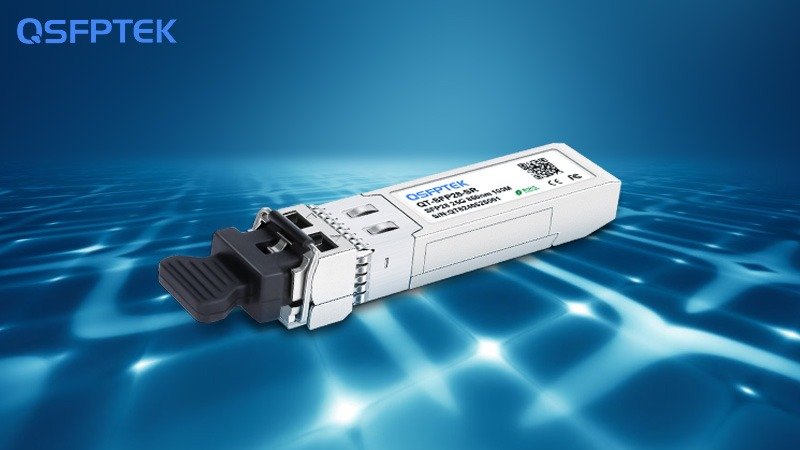
As the networking industry rapidly migrates toward 100G and 400G infrastructures, one might assume that lower-speed technologies like 25G are becoming obsolete. However, in reality, 25G SR (Short Range) transceivers continue to play a vital role in data center and enterprise network architectures—particularly in access layers and Top-of-Rack (ToR) connections. Their balance of performance, cost, and compatibility makes them a practical and enduring choice for modern network deployments.
The Need for a Balanced Network Architecture
While 100G and 400G modules are increasingly adopted in aggregation and core layers, not every part of the network requires such high-speed capacity. Access and ToR layers, which connect servers and storage systems, often experience moderate traffic levels that can be efficiently handled by 25G connections. Upgrading every link to 100G would be unnecessary and cost-prohibitive.
The 25G SR module provides a perfect middle ground, offering 2.5 times the bandwidth of 10G without a significant increase in power consumption or hardware complexity. It enables organizations to scale their networks incrementally while maintaining a cost-effective infrastructure.
Ideal for ToR and Leaf-Spine Architectures
In modern data centers, the leaf-spine topology has become the standard design. Here, the ToR (Top-of-Rack) or leaf switches connect directly to servers, while spine switches handle aggregation. The 25G SR module, based on SFP28 form factor, is ideal for these ToR uplinks due to its compact size, low power usage (typically under 1W), and reliable short-range performance up to 100 meters over OM4 multimode fiber.
This design ensures high-density, low-latency connections between servers and switches, supporting the growing demands of virtualization, containerization, and distributed workloads.
Seamless Integration with 100G Infrastructure
One of the key advantages of 25G SR lies in its scalability. It forms the foundation of 100G networks, as 100GBASE-SR4 modules are essentially built upon four 25G lanes. This means that upgrading from 25G to 100G can be done gradually without overhauling the entire physical infrastructure. Network operators can continue using existing multimode fiber cabling, simplifying migration and protecting previous investments.
Furthermore, many 25G SR transceivers are backward compatible with 10G SFP+ ports, ensuring interoperability during phased transitions.
Cost and Energy Efficiency
In hyperscale and enterprise environments, total cost of ownership (TCO) and energy efficiency are critical considerations. Compared with 100G and 400G optics, 25G SR modules are significantly cheaper and consume less power per port. Their SFP28 design also allows for higher port density on switches, optimizing space utilization and reducing cooling requirements in data centers.
These benefits make 25G SR particularly attractive for large-scale deployments where thousands of server connections must balance performance with operational efficiency.
Continued Relevance in the 400G Era
Even as 400G becomes the new standard for core network links, 25G remains deeply embedded in network hierarchies. It continues to serve as the preferred solution for access layers, edge computing nodes, and even AI training clusters where multiple 25G connections aggregate into higher-capacity uplinks.
In short, 25G SR is not a legacy technology, it is a complementary layer that ensures scalability and efficiency across network tiers.
Conclusion
As networks evolve toward 100G and 400G, 25G SR modules maintain their relevance by delivering the optimal balance of performance, cost, and scalability. They provide the reliable short-reach connectivity essential for modern ToR and access networks while supporting smooth transitions to higher-speed infrastructures. In the multi-speed data centers of today and tomorrow, 25G SR continues to be a key building block proving that evolution, not replacement, is the true path to progress.