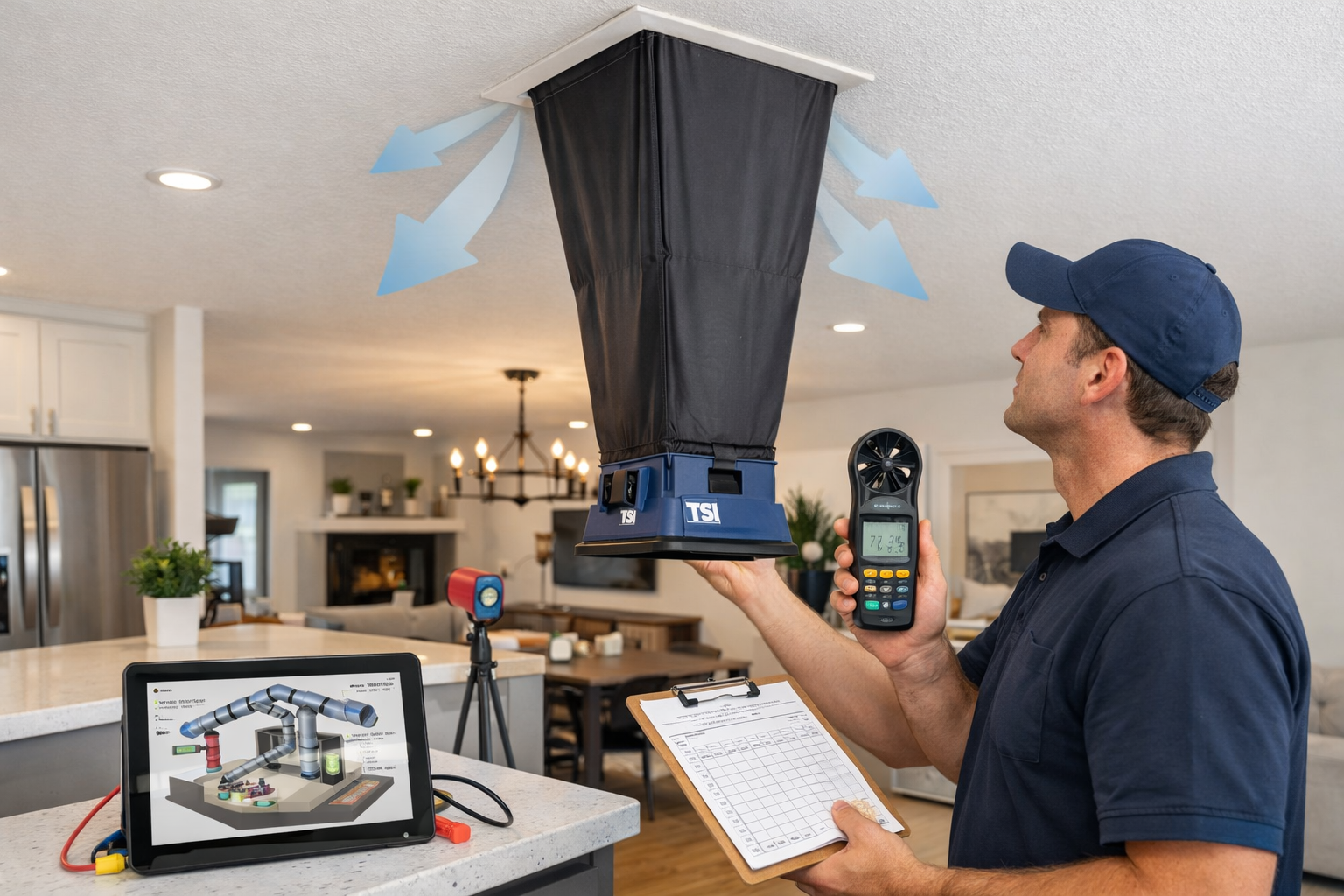
Open-concept floor plans feel spacious, but they can be tricky for HVAC airflow because the air does not behave as it would with walls in place. Large connected rooms create long-throw distances, strong temperature stratification near the high ceilings, and uneven pressure relationships between the open core and the closed bedrooms around it. Many homes end up with one big area that feels fine while nearby rooms run warmer, cooler, stuffier, or noisier. Airflow balancing is the process of delivering the right amount of supply air to each space and providing a clear return path back to the air handler, so the system can circulate air without creating drafts or dead zones. In open layouts, balancing is less about a single vent and more about how the entire system works together: duct sizing, register placement, return locations, door undercuts, and fan settings. When these factors align, temperatures stay steadier, humidity feels more consistent, and the system does not have to run as long to reach comfort.
Comfort depends on air pathways.
- Why open plans create uneven comfort zones
Open areas often include kitchens, living rooms, stairwells, and sometimes vaulted ceilings, which introduce heat sources and air movement patterns that do not match a simple duct layout. Cooking appliances, large windows, and electronics add heat in one corner, while shaded seating areas may feel cooler at the same thermostat setting. Warm air rises and can pool near ceiling peaks, leaving the lower living zone slightly cooler in winter and slightly warmer in summer, depending on supply placement and mixing. Meanwhile, bedrooms and offices remain enclosed, so they rely on their own supply volumes and return pathways to stay comfortable. If the open area has a large return grille, it can pull air aggressively, starving closed rooms of return flow when doors are shut. That creates pressure differences that reduce supply airflow into those rooms, even if the ducts are properly sized. Another common issue is long supply runs feeding distant rooms, which can cause higher friction losses and lower delivered airflow. The result is a home that feels inconsistent, with the thermostat satisfied in the open core while closed rooms drift. Balancing starts by recognizing that open plans change how air mixes, how heat moves, and how pressure differences form during normal daily use.
- Supply and return strategies that actually balance airflow
Balancing begins with the supply side because that is where comfort is delivered. Registers in open spaces should be placed to promote mixing without blasting occupants, often along exterior walls or near large glazing where heat gain and loss occur. In many open plans, a few larger supplies perform better than many small ones, but only if the ductwork is sized to keep air velocity reasonable and noise low. Return placement is equally important. A single large return in the open area may be convenient, yet it can create a dominant airflow loop that ignores closed rooms. Adding returns or using transfer grilles and jump ducts can provide bedrooms with a dependable path back to the system when doors are closed. This is particularly useful in humid climates where closed doors can trap moisture and reduce circulation. Contractors in areas like Greenville, SC, often see open plans that need return-path fixes more than new equipment, because pressure problems can mimic capacity issues. Balancing also involves dampers, either manual dampers in branch ducts or balancing dampers near the trunk, which allow a technician to reduce airflow to an overfed zone and redirect air to underfed rooms. The goal is measured delivery, not guesswork, so airflow readings and static pressure checks guide adjustments.
- Duct design, static pressure, and the hidden causes of imbalance
Open-concept homes often have duct layouts adapted from older designs without adjusting trunk sizes, branch lengths, and fittings to match the new geometry. When a few branches are short and straight, they can steal airflow from longer branches that feed back bedrooms or bonus rooms. This is not only about comfort but also about system stress. High static pressure makes the blower work harder, increases noise at the grilles, and can reduce coil performance, affecting both temperature and humidity control. A balanced system keeps static pressure within a safe range by using properly sized ducts, smooth transitions, and appropriate grille and filter choices. Filters that are too restrictive or return grilles that are undersized can cause pressure spikes that reduce airflow throughout the house, but the farthest rooms usually suffer first. Sealing duct leaks matters too, because leaks in attic or crawlspace runs can dump conditioned air outside the living zone, forcing higher fan speeds and longer runtimes. In open plans, leaks can also change pressure relationships, making certain rooms harder to condition. Good balancing includes verifying the basics: a clean blower wheel, the correct fan speed setting, unobstructed returns, and a duct system that isn’t restricting airflow before you even start adjusting registers.
Airflow balancing in open-concept floor plans depends on understanding how open spaces affect heat patterns, air mixing, and pressure relationships throughout the home. Large returns in open areas, long duct runs to closed rooms, and stratification near high ceilings can create uneven comfort even when the HVAC equipment is functioning normally. Effective balancing combines measured supply adjustments, reliable return pathways for closed rooms, and duct design choices that control static pressure and airflow theft. Ceiling fans, register aiming, and occasional seasonal tweaks support consistent mixing in large volumes, helping the system deliver the right airflow to each area and provide clear return routes. Open-plan homes feel more even, quieter, and easier to maintain at a stable setpoint.