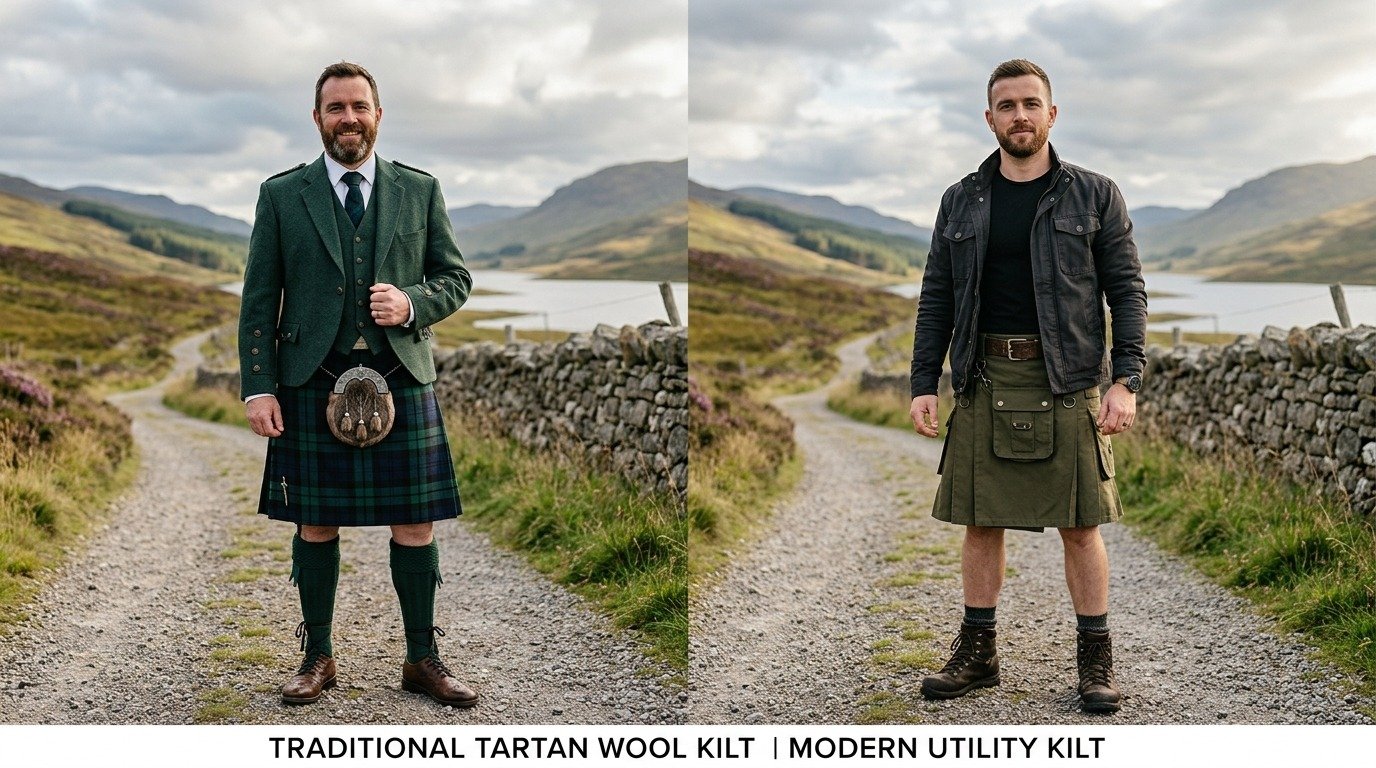
A few years ago I started a small experiment that turned into something more serious. I wanted to know — really know — which kilt style works better for someone who actually wears them in real life, not just for occasions and ceremonies. So I committed to wearing a traditional men’s kilt for 100 days, then a utility kilt for 100 days, and tracking how each one performed in normal Tuesday-to-Tuesday life.
What I learned changed how I recommend kilts to friends, family, and anyone who emails me asking which to buy first.
This isn’t a comparison written from a product page. It’s what 200 days of actual kilt-wearing tells you that nobody puts in a buying guide.
Setting the Test Up Fairly
To make this meaningful, I set ground rules:
– Both kilts had to be **mid-tier in price** — not bottom-shelf, not custom-made
– Both had to be worn for **everyday activities**: errands, work-from-home, social outings, light physical work, dinners, weekends out
– I would **not avoid challenging situations** to favor either kilt
– I would **note every issue** — comfort, weather, social, practical — as it happened
– After each 100-day period, I’d score the kilt across the same 10 categories
The traditional men’s kilt I tested: an 8-yard wool tartan in a heavy 16oz weight, mid-formal Argyll-compatible cut, around $280.
The utility kilt I tested: a heavy cotton-canvas utility kilt with cargo pockets, side buckles, and a relaxed waistband, around $130.
Different categories. Different prices. But both legitimate, well-reviewed examples of their type.
Day 1 to Day 30: The Honeymoon Phase
The traditional kilt felt like an event the first time I put it on. The weight of the wool, the sound of the pleats, the formality of just standing in front of a mirror — it’s an experience the first ten or fifteen times. I felt taller, more deliberate, more aware of how I was moving through space.
The utility kilt felt completely different. It felt practical. Within five minutes of putting it on, I’d loaded the cargo pockets with phone, keys, and a small notebook, and went on with my day. There was no moment of ceremony. It just felt like a useful piece of clothing.
Traditional kilt — early lead in **emotional impact**.
Utility kilt — early lead in **practical comfort**.
Day 30 to Day 60: Real Life Starts Testing Each Kilt
Around the one-month mark, both kilts started getting tested by genuine daily friction.
The traditional kilt’s first failure: rain
Wool kilts handle a light drizzle well. They don’t handle a sustained downpour. I got caught in heavy rain about six weeks in, and the kilt absorbed water like a heavyweight coat. By the time I got home, I had what felt like an extra five pounds of wet wool clinging to my legs. Drying it took two full days of careful air-drying to avoid shrinkage. I wasn’t going to do that to it again on a regular basis.
After that, every weather forecast became a deciding factor. Rainy day? Wear something else. Snow? Definitely something else. Hot and humid? Wool was uncomfortable. The traditional kilt, beautiful as it was, started becoming a “good weather only” garment.
The utility kilt’s first failure: a wedding.
Around the same time, I got invited to a fairly formal weekend event. I tried to dress up the utility kilt — nice shirt, decent shoes, dark belt. It looked fine for a casual ceilidh or backyard event, but for the actual wedding ceremony, it read as too casual. I switched to the traditional kilt for the day and was instantly more appropriately dressed.
The utility kilt has a ceiling. It can’t go formal, no matter how much you try.
Day 60 to Day 100: Where Daily Life Actually Happens
This is where the real differences emerged.
Pockets
The utility kilt destroys the traditional kilt on this. Two side cargo pockets, two back pockets, sometimes a thigh pocket. I could carry phone, wallet, keys, sunglasses, headphones, and a notebook without thinking about it.
Traditional kilts have no pockets. You need a sporran. The sporran works for formal events but is awkward for grabbing a coffee, going to the gym, or carrying gear to a friend’s house. I found myself dreading errands in the traditional kilt because of the pocket situation.
Real-world score: utility kilt wins decisively.
Comfort in Heat
Heavy wool tartan in 85°F humidity is a punishment. By 11 AM most warm summer days, I was actively uncomfortable in the traditional kilt.
The cotton utility kilt breathed dramatically better. It wasn’t perfect — no kilt is — but it was wearable on days the wool kilt simply wasn’t.
Real-world score: utility kilt wins for any climate above moderate.
Comfort in Cold
This was a surprise. I assumed the wool kilt would dominate cold weather. It does — but the heavy cotton utility kilt with insulated leggings underneath was actually fine for most autumn-into-winter days. The wool kilt was unbeatable for genuinely cold days, but the gap was smaller than I expected.
Real-world score: traditional kilt wins, but not by as much as you’d think.
Movement and Activity
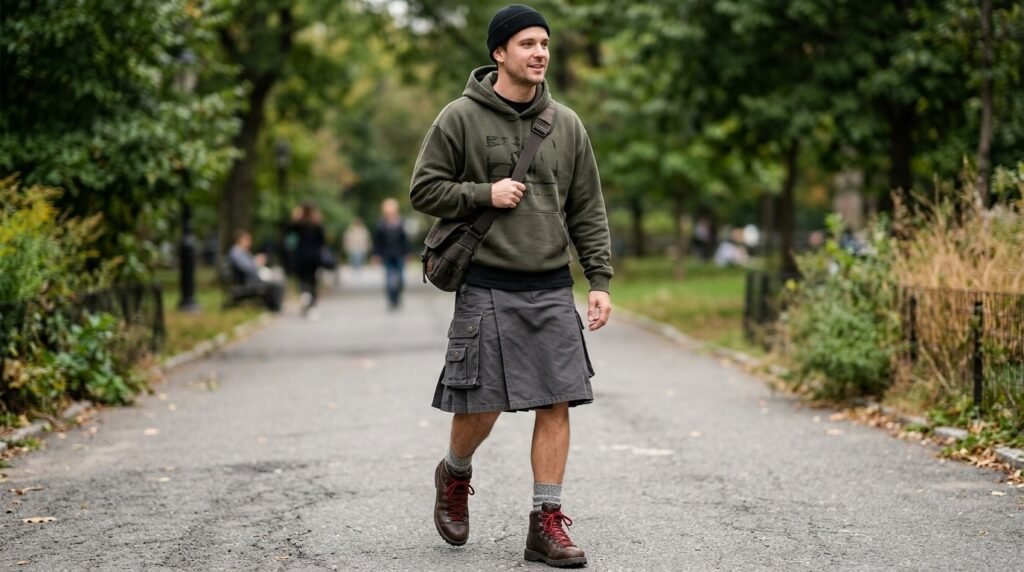
The utility kilt let me lift, climb, stretch, and move without thinking. The traditional kilt, with its 8 yards of pleated wool, has incredible range of motion in theory — but in practice, you’re conscious of it. You don’t squat down to grab something off a low shelf without first thinking about how the pleats will sit.
Real-world score: utility kilt for active daily life.
Maintenance
Utility kilt: machine wash, hang dry, done. Total maintenance time per month: about 10 minutes.
Traditional kilt: dry-clean only, hang on a proper kilt hanger, watch for moths in storage, never sit on it carelessly because the pleats can flatten in the wrong places. Total maintenance time per month: about 45 minutes including dry cleaner runs.
Real-world score: utility kilt by a wide margin.
Social Reactions
Here the traditional kilt won every single round.
Wearing the traditional wool tartan kilt, I got compliments, conversations, and curious questions almost daily. Older Scots would nod approvingly. Tourists would ask for photos. People at events would ask about the tartan.
Wearing the utility kilt, reactions were lukewarm. Most people didn’t know what to make of it. Some assumed it was a costume. A few thought it was cool. But the cultural recognition that comes with a real tartan kilt was missing.
Real-world score: traditional kilt wins hard.
Versatility Across Occasions
Traditional kilt range:
– Formal weddings ✓
– Burns Night dinners ✓
– Funerals ✓
– Highland games ✓
– Cultural festivals ✓
– Casual dinners ✓
– Errands ⚠️ (overdressed)
– Light work ✗
– Workouts ✗
Utility kilt range:
– Errands ✓
– Casual dinners ✓
– Outdoor festivals ✓
– Light work ✓
– Workouts ✓
– Concerts and events ✓
– Cultural festivals ⚠️ (works but less authentic)
– Formal weddings ✗
– Funerals ✗
Both win where the other loses. The honest answer is that they cover different halves of daily life.
The Verdict After 200 Days
Here’s what the test actually proved.
**For 100% daily wear, the utility kilts win clearly.** They’re more comfortable in more climates, more practical for errands and active days, easier to maintain, and they don’t require special weather. If you’re buying a kilt to actually live in, this is the one.
**For meaningful occasions and cultural recognition, traditional men’s kilts win clearly.** They carry weight that no utility kilt ever will. They earn respect at events. They photograph beautifully. They can be heirloom pieces.
**The real answer is that both belong in a kilt-wearer’s wardrobe, just like both jeans and a suit belong in any man’s wardrobe.** They’re not competing — they’re complementary.
If you can only buy one to start, the question becomes: do you wear kilts for occasions or for life?
If for occasions: traditional kilt first. You’ll wear it three times a year for things that matter, and it’ll outlast everything else you own.
If for life: utility kilt first. You’ll wear it three times a week for years, and you’ll never resent it for being inappropriate for the moment.
The Cost-Per-Wear Math
This is the unsexy financial side that nobody talks about.
Traditional kilt: $280 for the kilt, plus full outfit accessories pushing total cost to $700+. Worn maybe 12 to 20 times per year by a typical owner. Cost per wear over 5 years: roughly $7 to $12.
Utility kilt: $130 for the kilt, with maybe $50 in basic accessories. Worn 80 to 120 times per year by an active wearer. Cost per wear over 5 years: roughly $0.50 to $1.00.
The utility kilt isn’t just cheaper — it’s dramatically cheaper per actual wearing experience. The traditional kilt’s value comes from the rare moments it shines, not the hours it’s worn.
What I Wish I’d Known Before Day 1
Three things I’d tell my pre-experiment self:
1. **Don’t try to make one kilt do everything.** Both styles are specialists. Embrace that.
2. **The “right” first kilt depends on your real life, not your aspirational life.** Be honest about which events you actually attend.
3. **Quality matters more than tradition.** A great utility kilt outperforms a cheap wool kilt every single time. A great wool kilt is a treasure for life.
Frequently Asked Questions
Q:Are utility kilts considered “real” kilts?
They’re a modern evolution of the kilt format. Traditionalists may argue they’re not authentic to Scottish heritage, and they’re right — but utility kilts aren’t trying to be heritage pieces. They’re a practical garment in the kilt silhouette.
Q:Can I wear a utility kilt to a Scottish wedding?
Generally no. Most Scottish weddings expect traditional Highland dress. Wearing a utility kilt to a formal wedding will read as inappropriate to most guests.
Q:Which is more comfortable for first-time kilt wearers?
Utility kilts. The relaxed fit, side buckles, and casual cut are more forgiving for someone who’s never worn a kilt before. Traditional kilts have a learning curve in how they sit and move.
Q:Are utility kilts hot in summer?
Cotton-canvas utility kilts breathe better than wool kilts but worse than shorts. They’re comfortable into the mid-80s but become warm in extreme heat and humidity.
Q:How long does each style last?
A quality wool tartan kilt can last 20 to 50 years with proper care. A quality utility kilt typically lasts 5 to 10 years of heavy daily wear before showing significant signs.
Q:Can I wear underwear with both?
Yes. The “regimental” tradition (going commando) is purely optional and largely a personal choice. Most modern wearers, especially in non-traditional settings, wear underwear with both styles.
—
Two hundred days. Two kilts. One conclusion: there isn’t a winner — there’s a right answer for each kind of life. Be honest about yours, and the choice gets easy.